PROJECT DOSSIER
KeyScope · Evidence-led shortcut diagnostics
The problem
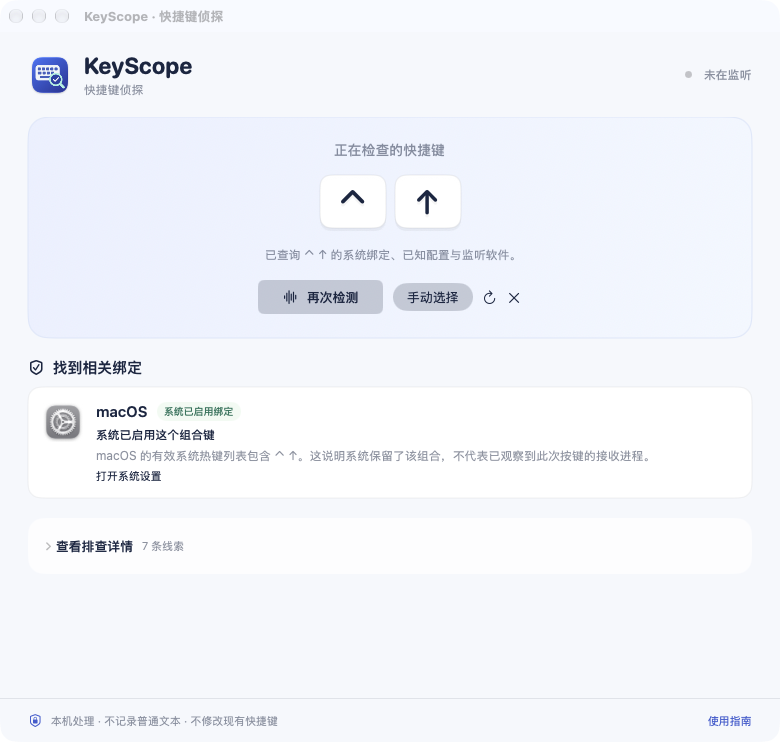
When a shortcut does not do what you expect, you need to know where it was dispatched and which configurations are worth checking. Listing every keyboard listener is easier, but listening alone does not prove ownership of a shortcut.
KeyScope is built around that distinction. It presents a confirmed receiving process, an explicit configuration match, a conditional match, and a listener-only clue as different kinds of evidence.
Implementation and verification
A native SwiftUI interface connects event correlation and configuration scanning. Live detection runs for one round and stops while keeping the result visible. Manual queries inspect system bindings and supported app configuration. The tool observes events; it does not modify or disable existing shortcuts.
Development checks use an independent receiver that temporarily registers a test combination. It does not synthesize key events and unregisters on timeout. Release checks cover downloaded package signatures, notarization of both the app and its outer DMG, and website downloads and demonstration media.
The website demonstrations show real-key receiver detection and manual queries. You can watch them before deciding whether to grant Input Monitoring permission.
Limits are part of the design
- It cannot identify every event filter that swallows keys or every internal app behavior. Insufficient evidence remains explicitly unconfirmed.
- A tested shortcut still performs its original action, so the user chooses which combination to inspect.
- The current UI and website demonstrations are in Chinese. It requires macOS 14 or later on Apple Silicon; physical-device validation was performed on macOS 27.
- The released app and DMG are Developer ID signed and Apple notarized. Live detection requires Input Monitoring permission.
- Source remains private. The public release repository contains product documentation and downloads, not an open-source code release.