WRITING
I Beat QQQ Today, and Broke Through My Own Floor for the First Time

Today was my first outperformance in four days: QQQ fell 0.90%, I fell 0.77%, a 0.14 percentage point win.
At that same close, my margin cushion went from 49.43% to 37.56% — under the 40% survival line I drew for myself, for the first time.
Both happened today, and the second matters far more than the first.
1. The 0.14 points I won are the other half of the 1.48 points I lost yesterday
Yesterday QQQ rose 3.40% and I only kept 1.91% — a 1.48 point gap, the widest since I started writing this ledger. Today QQQ fell 0.90% and I fell 0.77%.
Both days come from the same set of contracts.
I'm carrying 58 deep in-the-money covered calls — each one sold at the moment I bought the underlying shares, handing away all upside above the strike. Yesterday's rally: that layer gave back the gains almost dollar for dollar. Today's decline: the same layer caught more than a third of the drop for me.
Broken out by contribution to today's net asset value:
| Layer | Contribution to today's NAV |
|---|---|
| 58 deep ITM covered calls (incl. INTC / GOOG) | +3.28pp |
| Common stock (QQQ / INTC / GOOG) | −2.14pp |
| 18 January-2027 LEAPs | −0.89pp |
| Three same-day-expiry call spreads | −1.05pp |
| Total | −0.77pp |
The note layer made money today, and a decent amount of it. Had I done nothing at all, the day would have closed slightly positive.
So there is nothing for me to learn from "outperforming." The mechanism isn't judgment, it's the terms I signed: capped upside in exchange for downside cushion. In a rally it's a cost; in a decline it's a cushion. Same number, read in the other direction. That layer doesn't need improving — it worked exactly as designed.
What needs reviewing is the other 1.05 points.
2. Who broke the floor
First, how the number is computed — otherwise the attribution that follows means nothing.
The broker computes the margin cushion as: cushion = (net liquidation value − maintenance requirement) ÷ NLV, where maintenance requirement = 0.25 × stock market value + 1.00 × net option market value. The option term appears in both numerator and denominator and cancels completely — so it reduces to:
That isn't an approximation, it's an identity. Which means every action's effect on the cushion decomposes exactly: Δcushion = 0.75 × Δstock value + Δcash.
The cushion fell 11.87 percentage points today. Here's the breakdown:
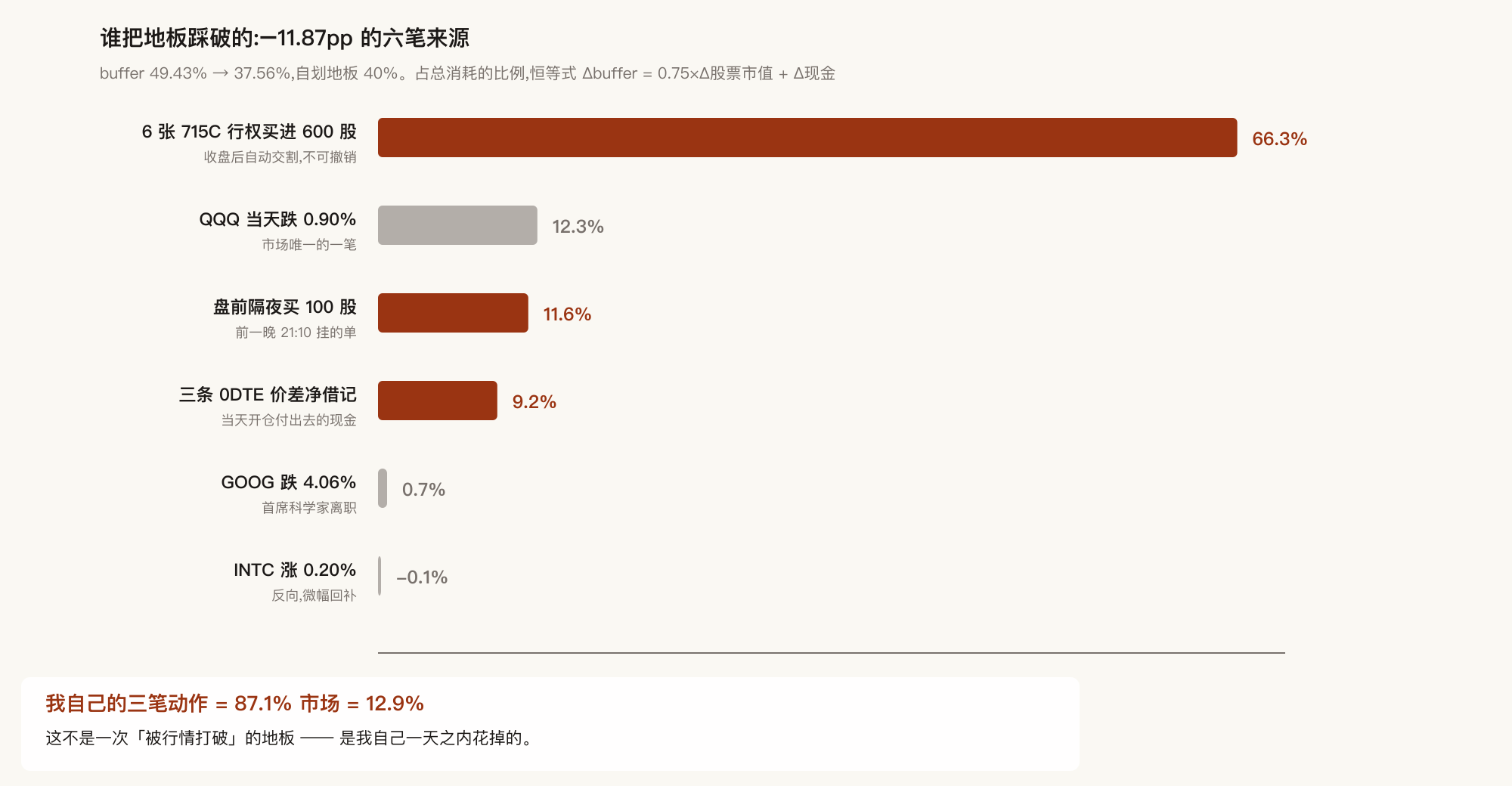
The largest single item is 66%: my 6 long calls expiring in the money and exercising, buying 600 shares at the strike.
The market accounts for 12.3%.
The line I had ready was "the market fell today, so of course the cushion thinned." The ledger doesn't support it: QQQ falling 0.90% consumed one eighth of the total. The other seven eighths I spent myself in a single day — 100 shares bought overnight, the net debit on three spreads during the session, and that one irreversible exercise.
This distinction isn't rhetorical. If the market thinned it, you wait for the market to give it back. If you spent it, you stop spending. Today the answer is unambiguously the second.
3. "Breaking the floor" is not "about to be liquidated"
This section has to be written, because conflating the two makes people take the worst possible action at the worst possible moment.
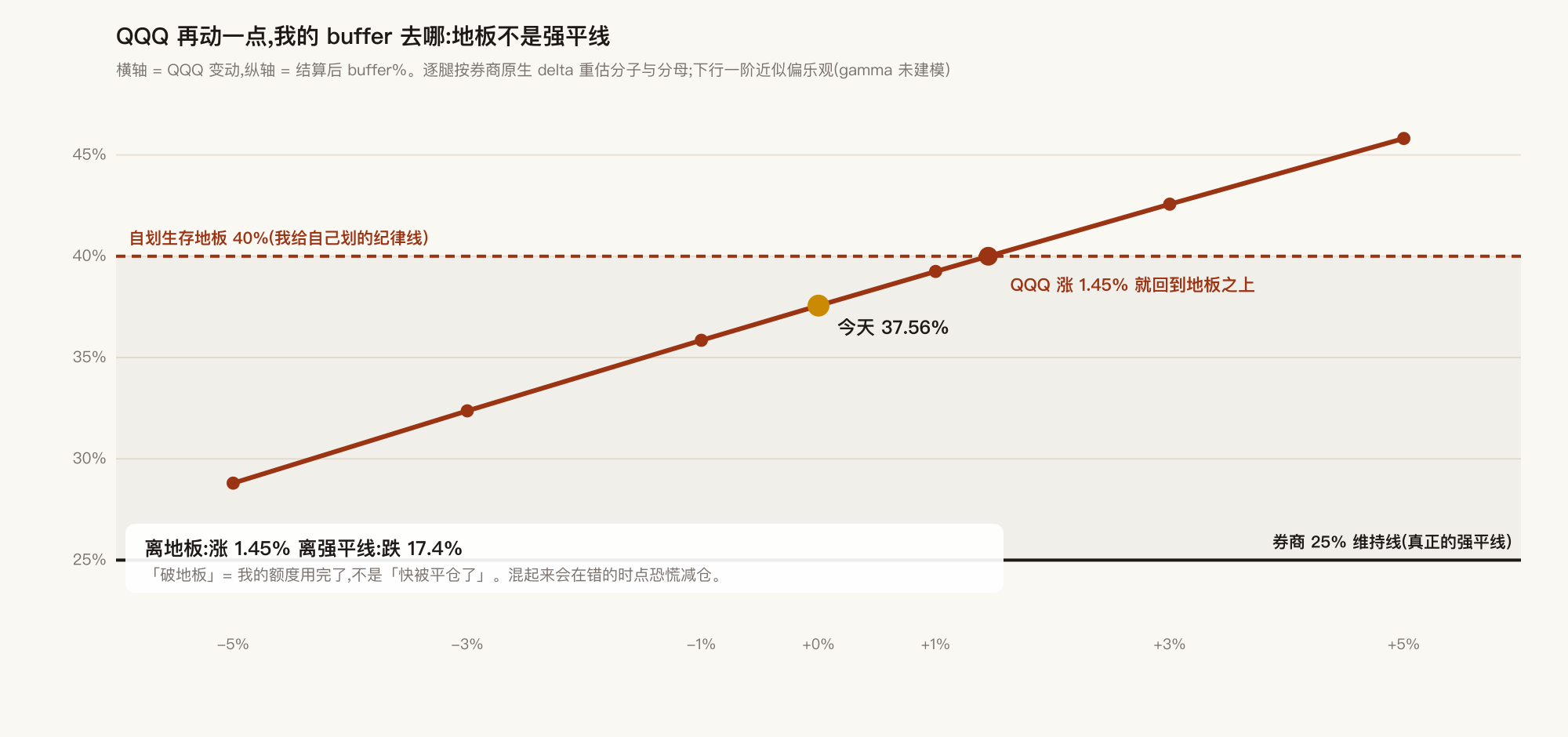
40% is a line I drew for myself. The broker's liquidation line is 25%.
| How far I am from each line | |
|---|---|
| From my own 40% floor | QQQ up 1.45% gets me back |
| From the broker's 25% line | QQQ would have to fall 17.4% |
QQQ only needs to rise 1.45% for the cushion to climb back above the floor on its own. The reason is in the identity: the numerator is 0.75 × stock value, which grows linearly with price, while the denominator — net asset value — has its growth suppressed by those 58 short calls. The ratio rises faster than the stock does. That is the mirror image of "a 2.71% drop touches the floor" from three days ago: the same leverage effect, amplified in both directions.
So the accurate description of today is: my self-imposed budget is used up, not that I'm close to being liquidated.
Then why treat it as serious?
Because the budget exists precisely for moments like this. A rule that only binds when you want to break it is the only kind that counts as a rule. I could easily say today "there's still 17 points to the liquidation line, what's the panic" — and that sentence works equally well at 40%, at 35%, at 30%, right up until the day it doesn't.
4. I got caught somewhere I had never considered
The 1.05 points I lost today came from three same-day-expiry call spreads. The direct cause is plain: I bought the wrong direction. These structures buy direction, they don't collect rent; yesterday's 3.40% rally maxed them out, today's 0.90% decline zeroed them. Two ends of one distribution. I accept that half — it needs no explanation.
What actually surprised me was how they settled.
One of them was long the 715, short the 721. The close was 717.30 — right between the two strikes.

I had always assumed this kind of spread self-liquidates at expiry: the long leg exercises into shares, the short leg gets assigned out of them, in and out, share count unchanged, cash roughly flat. That's exactly what happened yesterday — both legs deep in the money, and the position automatically deleveraged overnight.
Not today. The close landed between the legs: the long leg is in the money and exercises, the short leg is out of the money and nobody takes delivery. The result is that I pay full price for the shares and no one comes to take them away.
Same structure: settle above and it deleverages you automatically, settle in the middle and it leverages you automatically. And the second case happens to be the most cushion-expensive one, and happens to be what occurred today.
Written out, this property is obvious. The problem is that I never asked myself the question when I opened the position: if this settles between the two strikes, can I afford that exercise?
Today the answer was no. And I found out after the close.
5. There is also one purely execution error
At 11:57 I rolled the short legs of two spreads down (one from 728 to 722, one from 726 to 721), collecting a credit. Those two were right — that's bleeding-stopping after admitting the direction had gone against me, and net of the more expensive exit, the effect is positive.
At 12:23 I opened 20 more spreads in the same direction.
Twenty-six minutes apart. The first action means "I was wrong, stop the bleeding." The second means "let's go again." That batch alone cost about 0.11 percentage points.
The amount is small, but it is the only loss today that belongs neither to the structure nor to the market. For the 1.05 points I can say "this structure gains in rallies and loses in declines"; for those 26 minutes I have no defense at all.
6. Scoreboard
| Date | Me (TWR) | QQQ | Excess |
|---|---|---|---|
| 7/31 (Fri) | +1.00% | +0.64% | +0.36pp |
| 8/3 (Mon) | +1.64% | +1.77% | −0.12pp |
| 8/4 (Tue) | +1.91% | +3.40% | −1.48pp |
| 8/5 (Wed) | −0.77% | −0.90% | +0.14pp |
| 19-day cumulative | −0.09% | −0.83% | +0.74 index points |
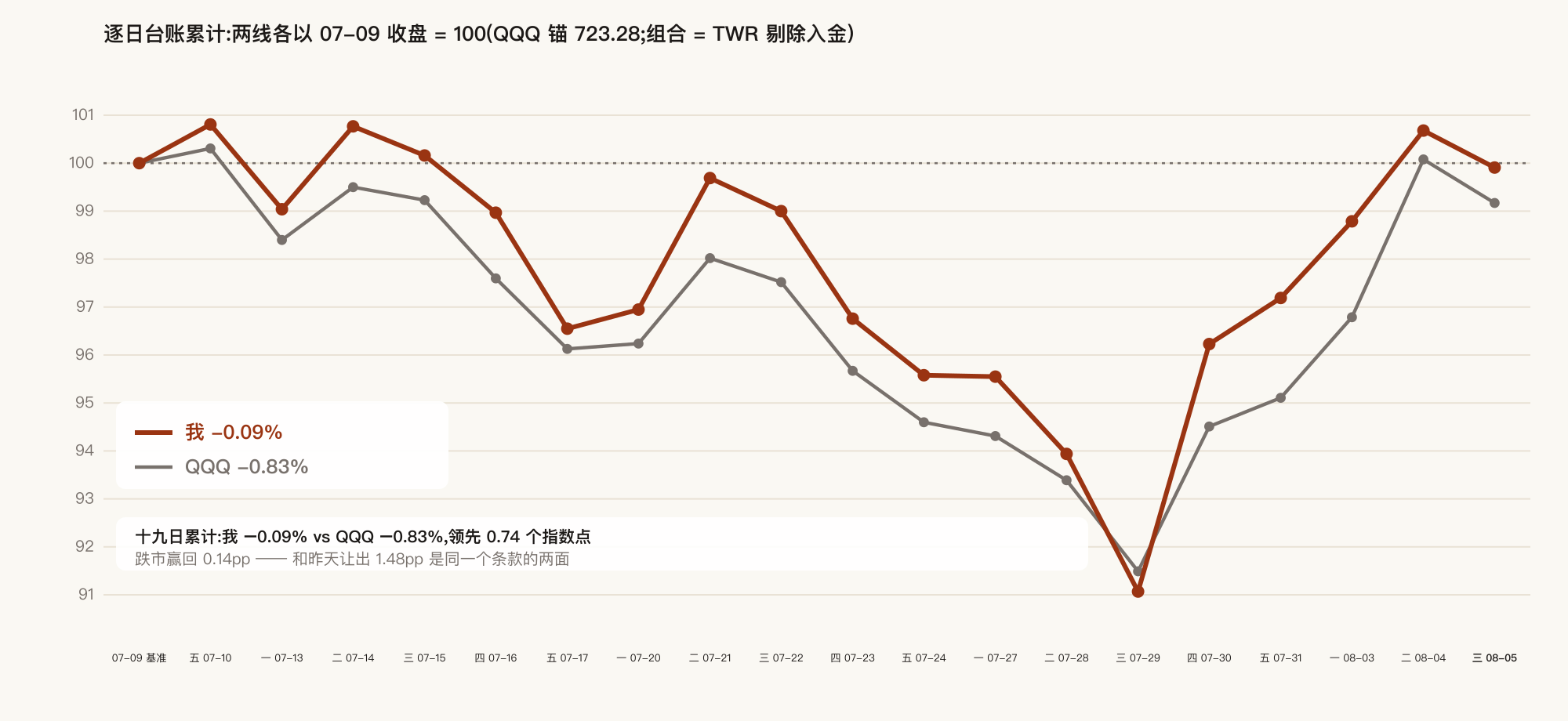
The lead narrowed from 2.00 index points to 0.74, essentially all of it in yesterday's session.
The current shape of this curve is worth a note: at the July 29 trough, my line was below QQQ's; from there it climbed back and is now above. What happened in between was not that I timed the bottom — it's that deep in-the-money covered calls lose less on the way down and gain less on the way up, flattening the whole path. The price of that flattening was already paid yesterday, in those 1.48 points.
7. Tomorrow isn't "don't add" — it's "reduce"
I've written "tomorrow's default is don't add" several times over the past few days. Today's conclusion is different: the budget is negative, and the rule calls for the opposite action.
One clarification, so this doesn't read as a bearish call: my other axis — net delta exposure — climbed today from 0.31× to 0.66×, and I added no directional exposure at all. QQQ fell, the deltas on those short calls collapsed together, and my net exposure grew on its own. By that axis I'm arguably under-long today, about 6 spreads short of full.
The demand side says add; the budget side says no. In that situation the budget side wins without exception — the survival constraint always outranks the allocation constraint.
As for how to reduce, one path requires nothing from me at all: 69 contracts expire together on August 21, sixteen days out. At today's prices most of them get assigned, which is a large-scale automatic deleveraging — enough to pull the cushion well back above the floor.
The most useful thing I can do today is refrain from anything over those sixteen days that would offset it.
Figures come from a real brokerage account (Robinhood) at that day's close, not a simulation. Amounts in this post are expressed as percentages or shares of total. This is a public self-accounting, not investment advice — especially don't copy the leverage.