WRITING
I Said "The Cushion Got a Lot Thicker" — Then I Opened the Books and Found I Was Half Wrong

My first reaction after the close was "the cushion got a lot thicker." That sentence was half right, and the half that was wrong is exactly the half that decides whether I can act tomorrow.
This is not splitting hairs. In my playbook the word "cushion" has always meant two different things, and normally they move together, so I have never been forced to tell them apart. Today they moved in opposite directions for the first time — one got thicker by 1.64 points, one got thinner by 4.81 points.
1. One Word, Two Sets of Books
The first cushion is each note's own safety cushion: how far the current price is from the breakeven. Every time I open a note, I buy the underlying shares and sell off, right then, all the upside above some strike; the premium I collect pushes my breakeven down. Only below that point do I start losing principal.
QQQ rose 1.77% today, and those breakevens were nailed down on the day I opened each position. So every single one is now further from losing principal: the weighted safety cushion across the same batch of 12 older notes went from 5.55% to 7.19%.
The second cushion is the margin buffer: how far I am from being force-liquidated by the broker. That number fell — from 48.58% to 43.77%.
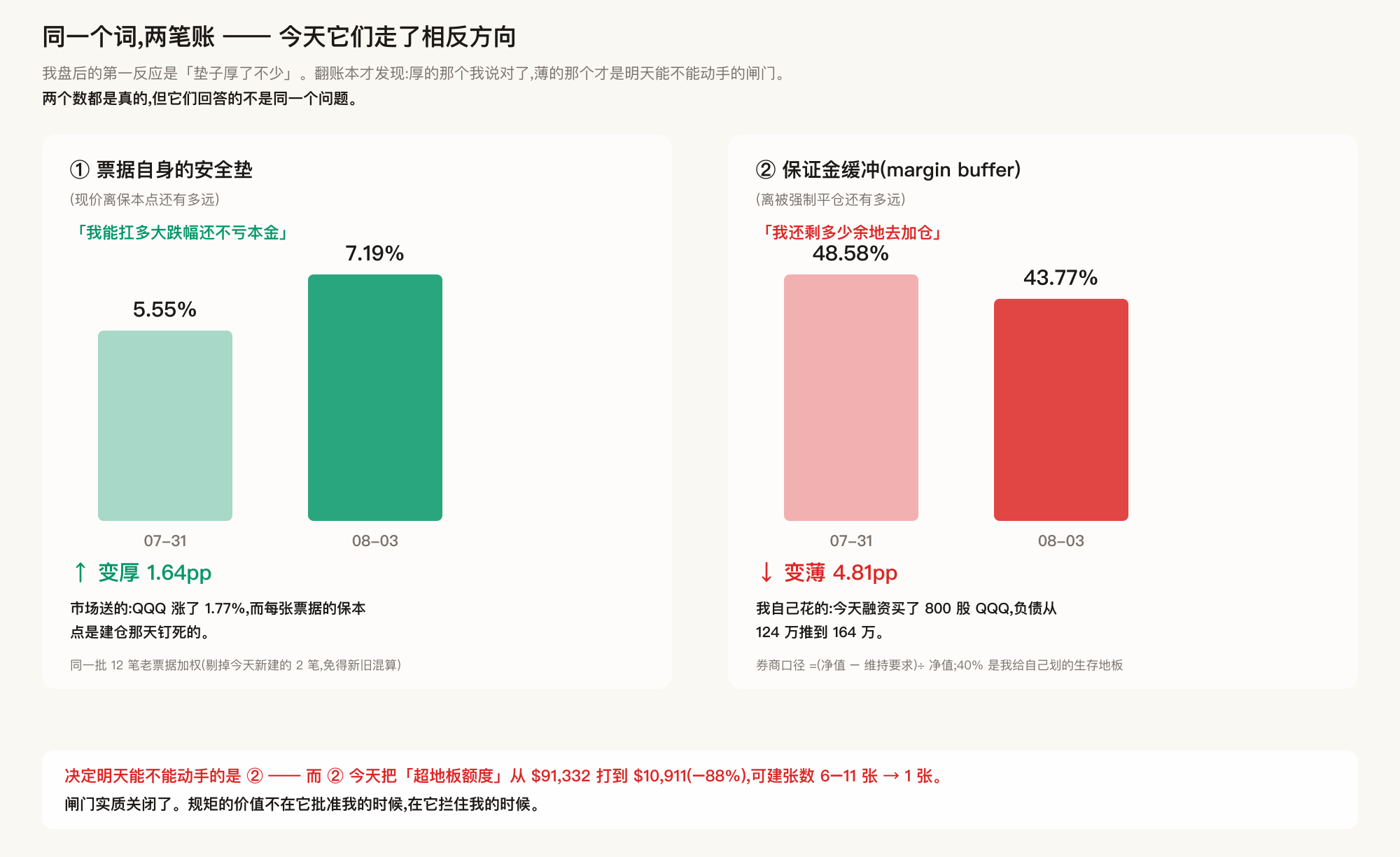
Both numbers are true, because they answer different questions. The first answers "how big a drop can I take before I lose principal," the second answers "how much room do I have left to add."
They parted ways today, and that is no coincidence either — two different things drove them: the first was a gift from the market (QQQ rose, the breakevens did not move); the second I spent myself (bought 800 shares on margin, debt pushed from $1.24M to $1.64M).
One was handed to me, one came out of my own pocket. Look at them mixed together and you get the conclusion "overall I am safer today" — and that conclusion would have me adding again tomorrow.
2. What I Actually Spent Today
On the P&L, today was a gain: NAV +1.64%, twenty thousand nine hundred dollars.
But what actually got consumed on the books was not money, it was room.
I once wrote myself a position-opening quota formula:
40% is the survival floor I drew; only the part above the floor is money I can spend on positions. That numerator — I call it the "headroom above the floor" — traced this path over three days:
| Date | Headroom above the floor | Notes I could open |
|---|---|---|
| 7/30 (after expiration assignment) | $353,349 | 27–42 contracts |
| 7/31 | $91,332 | 6–11 contracts |
| 8/3 (today) | $10,911 | 1 contract |
Two trading days, from 42 contracts down to 1.
Last Friday I wrote that this rule had "run a full lap for the first time" — quota given, positions opened against the quota, still above the floor at the close. Today it ran the other half lap: the quota is spent, and the rule starts saying no.
I am pulling this out separately because the value of a rule is not in the moment it approves you. When it approves you, you wanted to act anyway. Its entire value is in the moment it stops you, and today is the first time it really stopped me.
The buying power number is blunter still: from $860K down to $61K. I cannot even afford a single round lot of QQQ now.
3. One Ordinary Pullback Day From the Floor
"43.77% left, 3.77 points above the 40% floor" — that sounds like there is still slack. There isn't.
Because the numerator and the denominator move together. QQQ falls, the stock market value shrinks (numerator drops fast), NAV shrinks too (denominator drops slower), and the ratio walks down far faster than intuition says. I re-marked every leg individually using the broker's delta, and drawn out it looks like this:
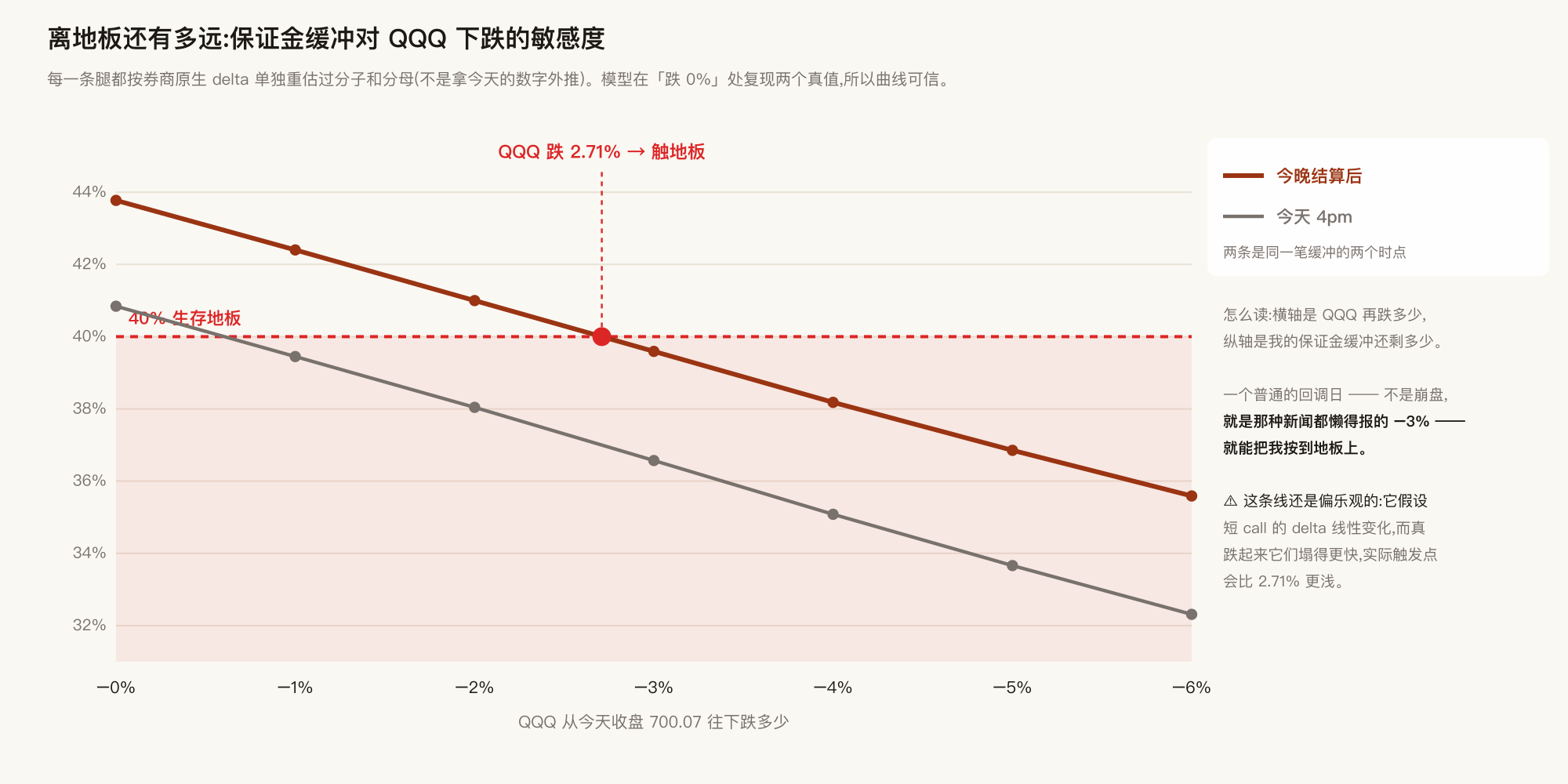
QQQ down 2.71% and I am flat on the floor.
What kind of number is 2.71%? It is the kind of day the financial press does not bother to write a separate story about. Just four days ago, on July 29, QQQ fell 2.03% in a day, I did nothing at all, and the buffer went from 38.75% to 35.48%.
And this curve is still on the optimistic side. It assumes my short calls' deltas change linearly; in a real drop they collapse faster than linear — the short calls' hedge disappears on its own and my net exposure automatically expands. The real trigger point is shallower than 2.71%, I just cannot pin down by how much.
So "3.77 points to go" is a phrasing that lies. The honest phrasing is: one ordinary pullback day.
4. My First Time Using a Spread Instead of Shares
After 11 o'clock today, buying power hit bottom. To keep eating the day's upside, buying the shares was not a road I could walk — not that I did not want to, I could not afford to.
So I switched stances: bought 5 QQQ 690/697 call spreads at 6.21 each.

Both routes eat the same stretch of the move, but the survival quota they consume differs by 28 times.
Buying stock on margin always eats 25% of market value in buffer — that is not an estimate, it is an identity that falls straight out of the formula. 500 shares at $348K eats $87K of buffer.
Buying a debit spread eats exactly the money you paid out, not one cent more. 5 contracts totaling $3,105, and the usage is $3,105.
The close tonight was 700.07, both legs are in the money, the spread takes the full 7.00, making $395. Measured by "how much each dollar of buffer earned," it is 8 times buying the shares.
I will write the cost out in the open, two items:
First, the upside is sealed at 7.00. If QQQ had closed at 710 tonight, buying the shares makes $6,350 and my spread still makes $395. That is not a defect, that is the buffer I bought with upside.
Second, its effective purchase cost is 697.91, 61 cents more expensive than buying the shares outright in the same window at 697.30.
Those 61 cents are the sticker price of "not eating buffer." When the buffer is still thick it is not worth paying — back then you have quota to spare, so why cap your upside. When the buffer is flat on the floor, it is the only road still open.
The same tool is a completely different thing under different account states. I used to understand spreads only from the "defined-risk" angle; today is the first time I got a feel for their other half.
5. The 0.12 Points I Lagged QQQ By
NAV today +1.64%, QQQ +1.77%, I lagged by 0.12 percentage points.
This is structural inevitability, not a mistake, and I think it is a very good result for this structure to deliver today.
The reason sits in one number: the weighted net delta of my 50 deep in-the-money covered calls is only 17.9%. Nominally I hold 4,200 shares of QQQ; economically only about 750 shares are eating this rally. The upside on the other 3,450 shares was sold to someone else back on the day I opened.
So why lag by only 0.12pp instead of 1.4pp?
Because of the 18 LEAPs expiring in 2027. They made $17,238 today, 82% of my entire profit for the day. They are deep in-the-money, delta 0.83; when QQQ rises they follow almost fully, and the short calls sitting on top of them are only the two most out-of-the-money strikes, 680 and 700.
This is the whole reason I split the book into a "steady" end and an "aggressive" end: the steady end necessarily lags in a rising market, so something has to be there to track the rally in its place. Today is the first time this design paid off in such a clean form — one end drags, one end makes it back, and together they come up just 0.12 points short.
A word on GOOG while I am at it, running the same lesson for a second straight day: the shares rose 4.42%, my 300C dropped 97% in step, leaving $46. Yesterday that number was 96%. This is not a mistake, it is the terms I signed on July 23 paying out on schedule.
6. Scoreboard
| Date | Me (TWR) | QQQ | Excess |
|---|---|---|---|
| 7/30 (Thu) | +5.67% | +3.30% | +2.38pp |
| 7/31 (Fri) | +1.00% | +0.64% | +0.36pp |
| 8/3 (Mon) | +1.64% | +1.77% | −0.12pp |
| 17-day cumulative | −1.21% | −3.21% | +2.00pp |
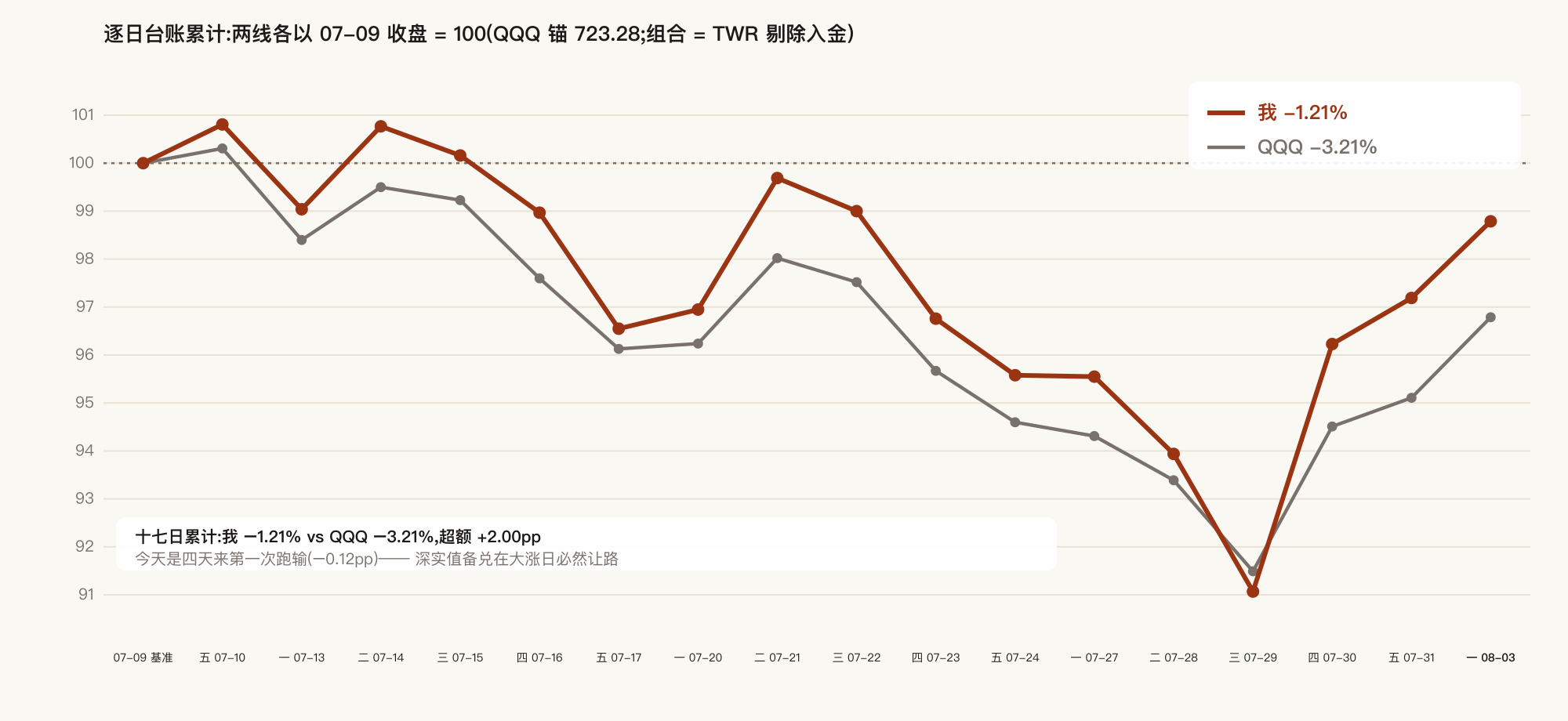
First time lagging in four days. The lead narrowed from 2.08pp to 2.00pp.
Those 0.08 points given back are ones I am willing to pay — what they bought back is the stretch of road that did not get punched through during the mid-July drop. The steepest part of this curve is not the last few days of gains on the right, it is the pit on July 29: that day I fell to 91.07, QQQ fell to 91.49, and my curve was below. Now I am above. What happened in between was not me calling the bottom, it was my deep in-the-money calls losing less on the way down.
7. No Adding Tomorrow
Writing this far, the only judgment left to make today is one sentence: tomorrow's default action is not to add.
Not because I am bearish. Today's market structure favors me — oil crashed 6%, the Dow hit a record high, the AI narrative is back, and my 216% position is riding on exactly that container. If I looked only at fundamentals, I should add tomorrow.
But the gate's number is 1 contract.
I know how I think at moments like this: the quota is one I set myself, the 40% is a line I drew myself, the tape is this good, so what if I loosen it a little. That is precisely why that line has to be drawn in advance rather than made up on the day. Today's me is not the one who drew the line; today's me is the one the line stops — and those two identities cannot be the same person at the same moment.
If I really want to act, there is something I can act with: that 690/697 spread today showed me a stance that does not eat buffer exists, it just costs upside. When the buffer is flat on the floor, only someone willing to cap their upside deserves to stay on the field.
As for long-end rates — last Friday I wrote that they are "the only counterparty not priced into this structure," and back then I said the buffer still being at 47% was my only reason to keep ignoring them. Today that reason is down to 43.77%, and my debt is $400K larger. I moved this item's priority up today.
Numbers come from a real brokerage account (Robinhood) on that day's closing basis, not simulated. Amounts are presented in percentage or per-share terms throughout. This is a public exercise in self-accounting and does not constitute investment advice of any kind — especially do not copy the leverage.