WRITING
The Seven Calls I Thought I Sold 'Naked' — Their Caps Were the 700 Shares Bought in the Same Minute

The load-bearing sentence in the first version of this review was wrong. What I wrote that night was: "Both spreads hit their caps in full, and I still lost money on options that day — the loss came from the seven extra naked calls I sold." The next day, reconciling line by line against the broker's order flow, the conclusion had to be flipped entirely: behind every one of those seven calls stood one hundred shares of stock bought that same day; the full set of that day's trades didn't lose at all — it made 4,908 dollars.
I'm not deleting the wrong ledger. This version records exactly how it went wrong, and where the knife fell. Because what's truly worth writing down this time isn't the money — it's how two checks that confirmed each other managed to be wrong together.
1. Scoreboard: One Day Ate Seventy Percent of the Lead
The numbers in this section were not wrong; they stay as they were.
| Today | Yesterday | |
|---|---|---|
| Me | +1.91% | +1.64% |
| QQQ | +3.40% | +1.77% |
| Gap | −1.48pp | −0.12pp |
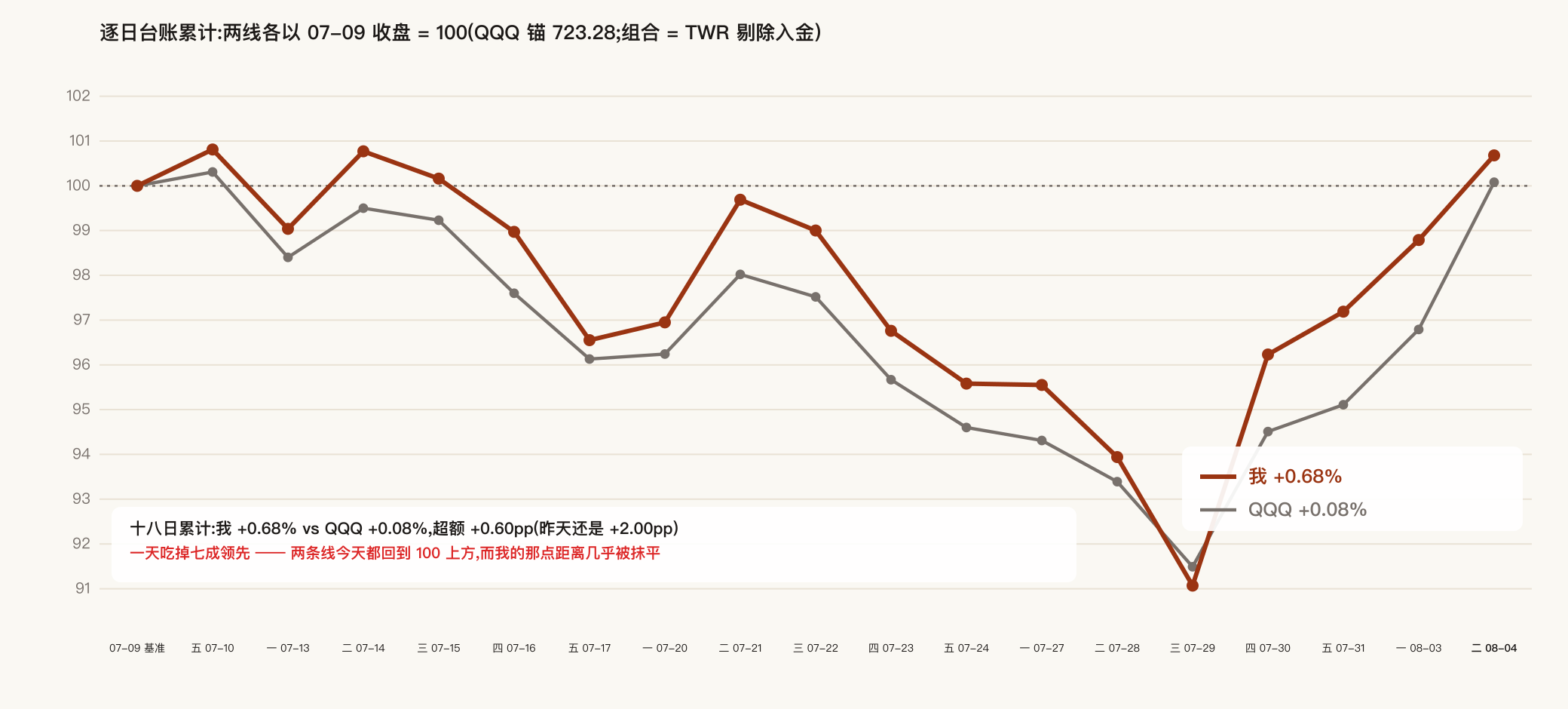
QQQ went from 700.07 to 723.85 today, up 3.40% — the biggest green candle since I started writing this series. I made +1.91%, trailing by 1.48 percentage points; the 18-day cumulative lead shrank from 2.00 percentage points to 0.60. One day ate seventy percent of it.
That gap is real, and it's the bill this "sell the upside for certainty" structure is bound to pay on a big up day. But the ledger I wrote that night for "who lost the money" was false.
2. What Stopped Me Was a Hard Rule of My Own
The first version said: outside the two spreads, I had "separately sold seven calls with no cap," and however high QQQ climbed was however much they lost.
But I have a rule I set in stone for myself: never sell naked calls. Every call I sell must have either one hundred shares of stock behind it, or a long leg. I have never broken this rule. So the first version's claim left only two possibilities: either I broke the rule, or the ledger was wrong.
I went and matched the broker's order flow timestamp by timestamp:
| Stock order (Eastern Time) | Option order | Gap |
|---|---|---|
| 09:42:01 buy 400 shares @712.94 | 09:42:13 sell 4× 713C @2.76 | 12 seconds |
| 11:40:44 buy 200 shares @718.64 | 11:40:58 sell 2× 718C @2.17 | 14 seconds |
| 12:21:47 buy 100 shares @719.83 | 12:22:00 sell 1× 720C @1.69 | 13 seconds |
All three were buy-writes — buy the stock first, sell the call within a dozen-odd seconds. Seven calls, seven hundred shares, paired one to one, not a single one flying solo. The broker's positions page puts it even more bluntly: that column is literally labeled Stock Collateral — which shares are pinned behind each call sold, it keeps track for me. This account is structurally incapable of opening a naked sale.
How did the first version go wrong? I wrote "no long leg" as "no cap." A long leg was never the only kind of cap — stock bought in the same minute is a cap too.
3. Two Ledgers: The Same Batch of Orders, One Says −900, One Says +4,908
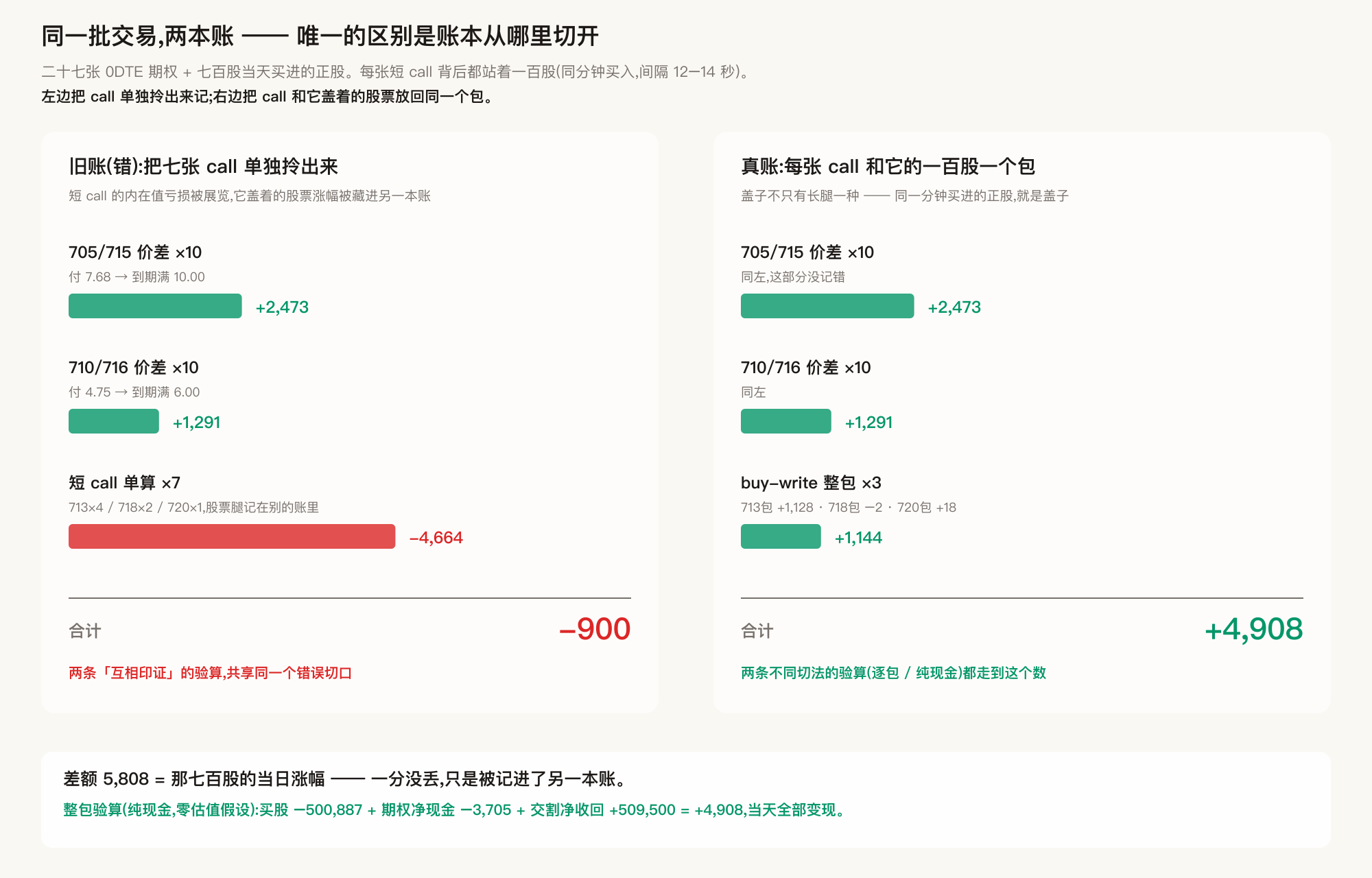
The old ledger (wrong): pull the seven calls out and compute them on their own —
- The four 713s: collected 2.76, settled at 10.85 intrinsic value, lost 809 each;
- The two 718s: collected 2.17, the broker bought them back for me at 7.39 near the close, lost 522 each;
- The one 720: collected 1.69, bought back at 5.53, lost 384.
The seven together: −4,664; the twenty spread contracts together: +3,764; summed: −900. "The capped ones made money, the uncapped ones lost" — the story flowed nicely.
The true ledger: put each call back into the same package with the hundred shares it covers —
| Package | Stock leg | Call leg | Whole package |
|---|---|---|---|
| 400 shares + 4× 713C | Bought at 712.94, assigned away at 713 | Premium 2.76 fully pocketed | +1,128 |
| 200 shares + 2× 718C | Bought at 718.64, shares kept (close 723.85) | Collected 2.17, bought back at 7.39 | −2 |
| 100 shares + 1× 720C | Bought at 719.83, shares kept | Collected 1.69, bought back at 5.53 | +18 |
The three packages sum to +1,144. Add the two spreads' +3,764 (ten 705/715s paid 7.68 and collected the full 10.00, ten 710/716s paid 4.75 and collected the full 6.00 — this part the first version got right), and the full set of that day's trades made +4,908.
How was the −900 manufactured? Every cent of intrinsic-value loss on a short call corresponds to an equal-sized gain on the hundred shares covering it. Book the call on its own, and the stock leg's gain stays in another ledger — the loss gets put on display, the profit gets hidden. That's how the −900 was cut out.
The hardest check of all: this play self-liquidated that same day. Over the day I bought 1,700 shares (700 bought at market, 1,000 bought via exercise) and delivered 1,700 shares (sold via assignment); all the 0DTE options went to zero that night. Everything in and out turned into cash, with no valuation assumption needed:
The money spent buying stock, the net option cash flow, the net proceeds from delivery — all three numbers are verbatim from the statements. The cash is already sitting in the account.
4. How "Two Independent Checks" Managed to Be Wrong Together
This is the part I most want to write down. In the first version I did verify — I took two routes, one computing contract by contract, one by cash flow, and both routes arrived at −900, confirming each other. At the time I took that as ironclad proof: "This number isn't something I computed — it's what the ledger itself looks like."
Looking back now: the contract route pulled the seven calls out on their own; the cash route priced the seven hundred shares I delivered at the closing price, 506,695 — instead of the 500,887 I actually paid that morning. The two routes made the same cut in the same place: both excluded the stock leg from the package. The difference, 5,808, is exactly what cut +4,908 into −900.
Two checks agreeing only proves they cut in the same place — it doesn't prove the cut was right. Truly independent checks must cut along different boundaries — one computing package by package along the structure, one by pure cash, like this version: each route walks on its own to +4,908. That is what agreement means.
5. My First After-Hours Reaction Was Wrong Once Too — But That One Got Caught the Same Night
The moment the market closed I looked at my margin buffer: 39.60%, right on my 40% survival floor. First reaction: stop tomorrow.
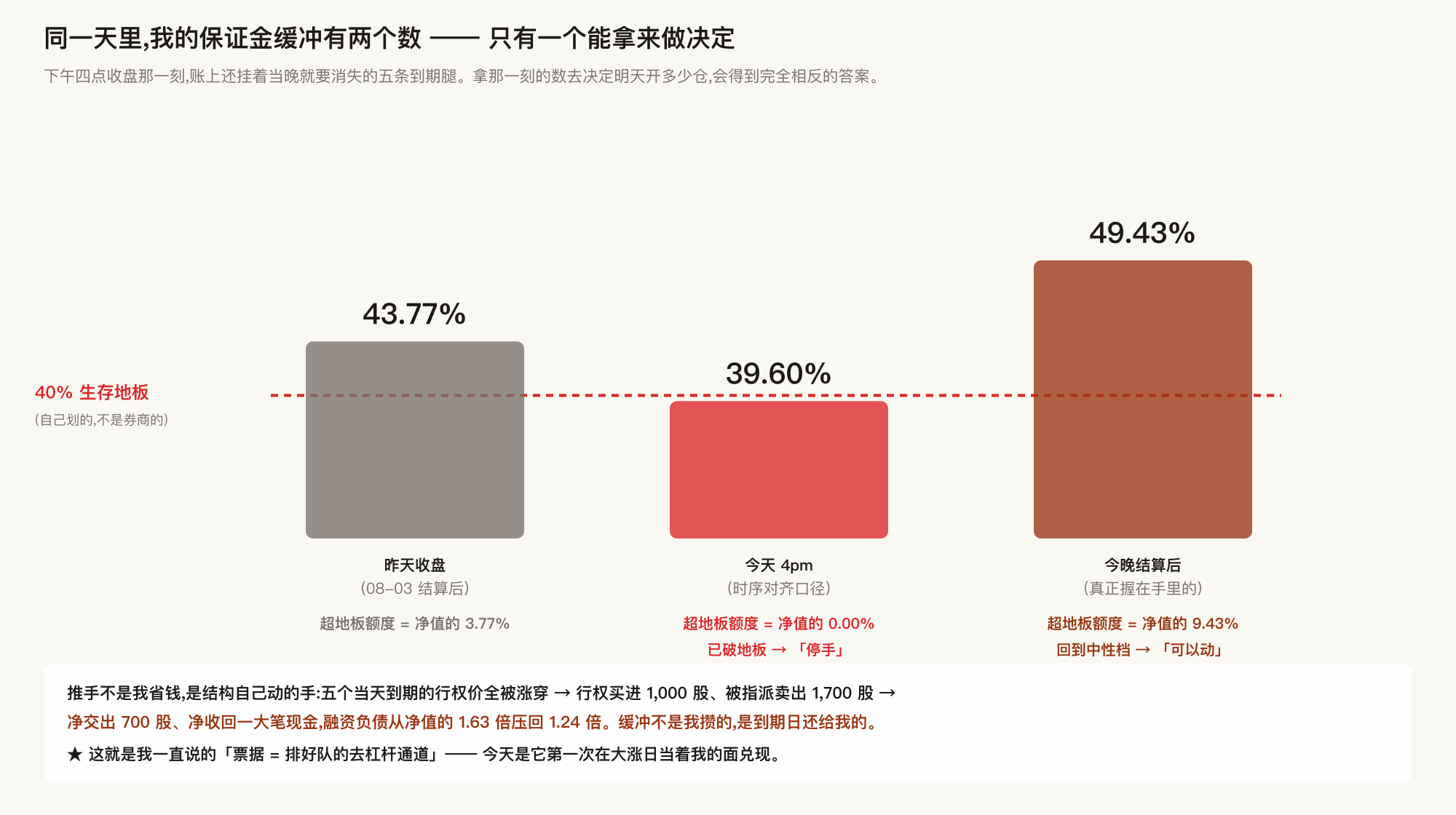
The mistake was looking at the account as of 4:00 sharp. At that moment the account still carried five expiring legs whose settlement would complete that very night: 1,000 shares bought via exercise, 1,700 shares sold via assignment, 509.5K in net cash recovered, financing liability compressed from 1.63× of net worth back to 1.24×. Once settlement completed, the buffer was 49.43%.
Not 39.60 — 49.43. One says "stop"; the other says "you can move." I've already written the rule into my tooling: the 4:00 snapshot is used only to align with history; tomorrow's decisions always use the post-settlement one. And since expiring legs are booked at intrinsic value, settlement is zero-sum: net worth before and after settlement must match exactly, and if it doesn't, refuse to emit the report.
What deserves an extra look is why the buffer thickened: not because I saved money, but because the structure moved on its own. Every call sold carries an expiry date, and when that day comes, the part that rose automatically converts stock into cash and pays down a chunk of the liability. The harder it rises, the more it pays down. Today was the first time this "queued-up deleveraging channel" cashed in on a big up day right in front of me.
6. The Second Axis: Hedge Ratio
The buffer is sufficient — how much should I open tomorrow? I used to have only the buffer as an axis, and its answer today was "enough for a hundred-plus contracts" — which obviously answers "can I afford to add," not "should I add."
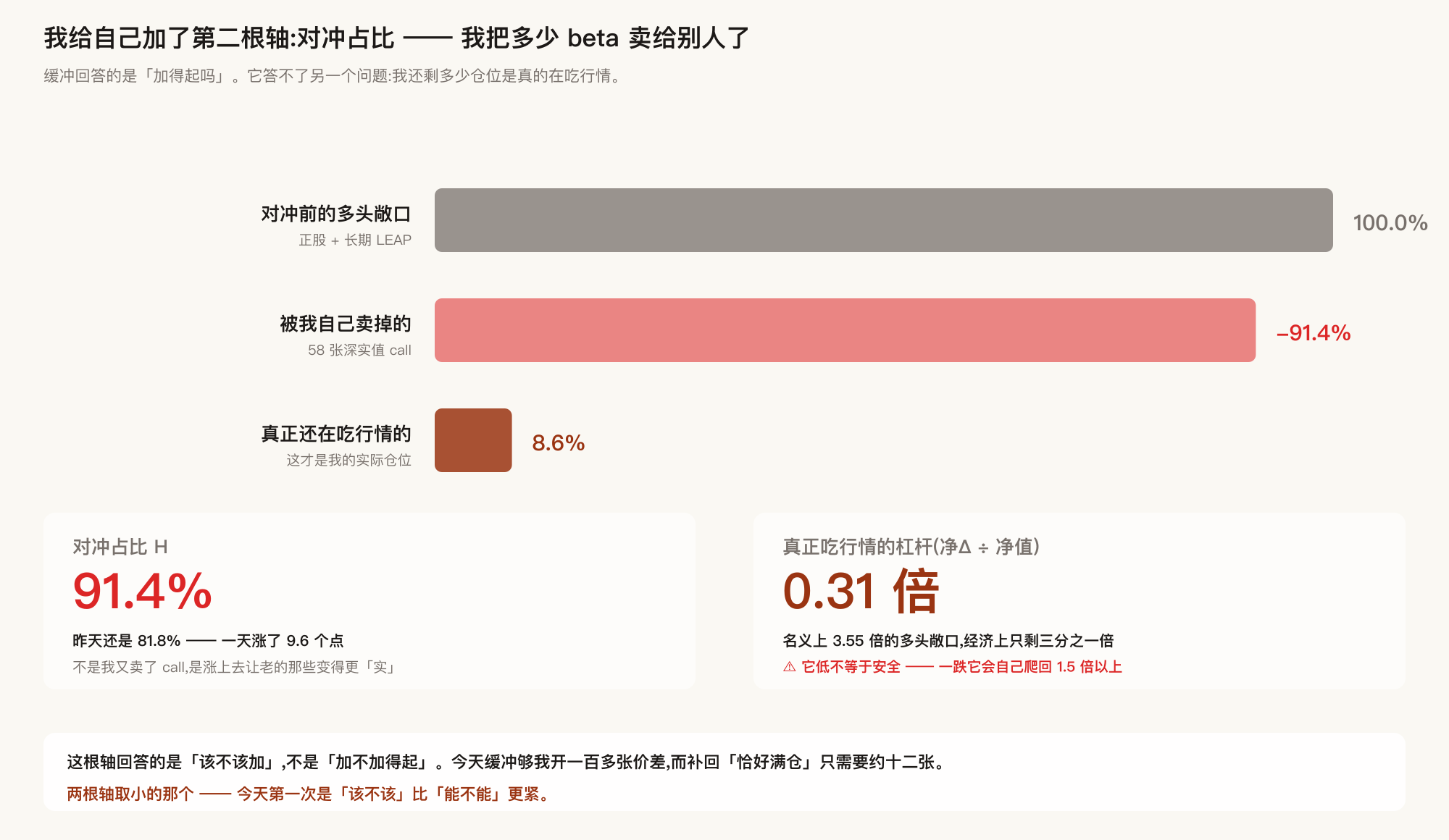
Add up all long exposure (stock plus long-dated LEAPs), subtract the part eaten by the calls I've sold, and what remains is the position actually still riding the market:
- Long exposure before hedging: 100%
- Sold away by my own hand: −91.4%
- Actually still riding the market: 8.6%
I have sold 91.4% of my beta to others. Yesterday that number was 81.8%. Not because I sold anything more today — not one extra contract — but because QQQ's rise pushed the old calls' deltas from 0.83 collectively above 0.90. Nominally 3.55× long exposure, economically only 0.31× remains.
How the two axes work together: the buffer is the ceiling, the hedge ratio is the demand — take the smaller of the two. The buffer says I could open a hundred-plus; getting back to "exactly fully invested" takes only twelve. This is the first time in two days that "should I" is tighter than "can I."
One sentence that has to be written in plain sight: 0.31× does not mean safe. It's low because the up market pushed the short calls' deltas high; on a drop, those deltas collapse together and net exposure climbs back above 1.5× on its own — on July 29, when QQQ fell to 661, it spiked to 2.01×.
7. The Whole Book of Notes Is Now a Bond
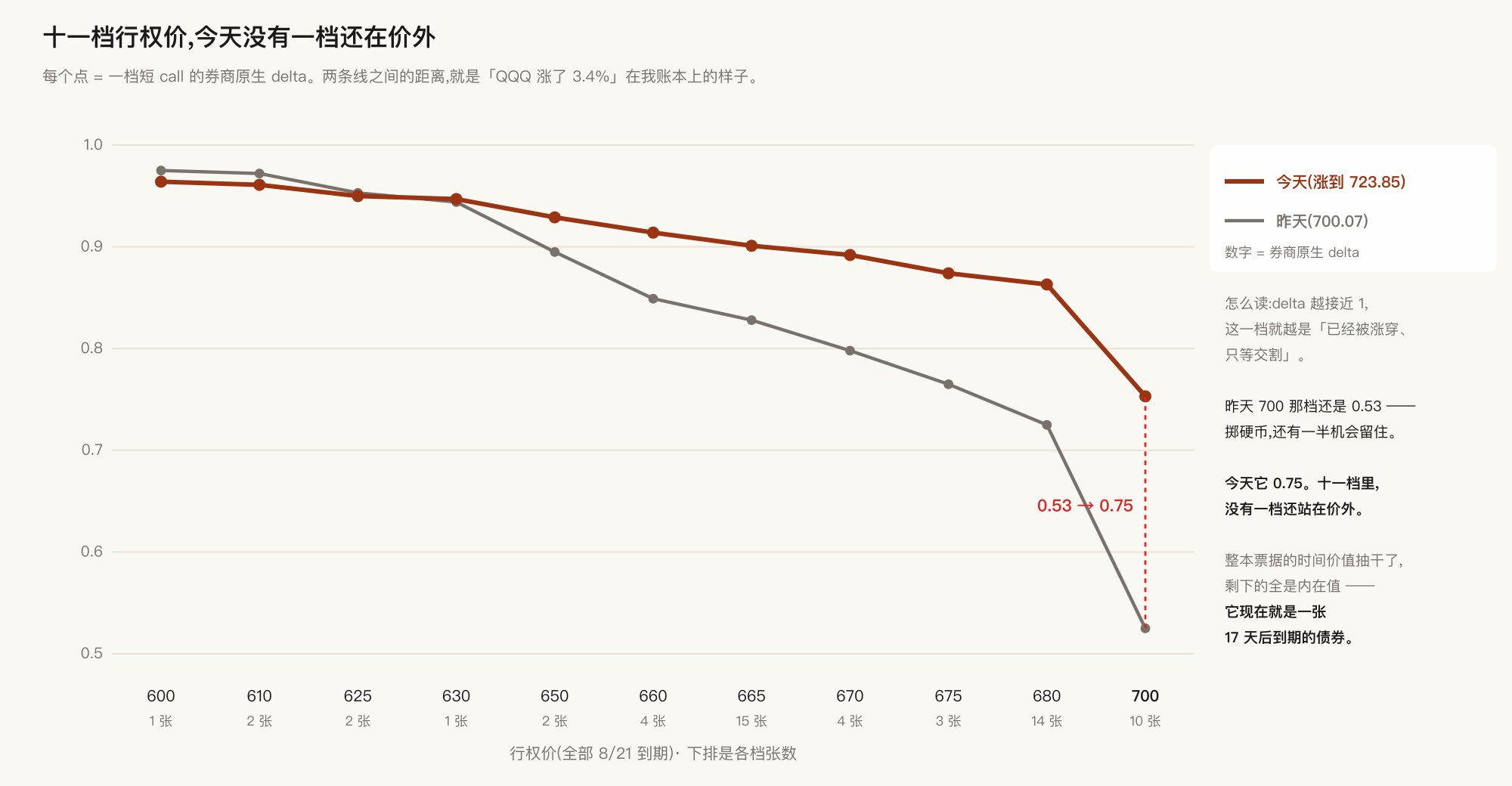
Fifty-eight calls expiring August 21, strikes laddered from 600 to 700. Yesterday the topmost rung, 700, was still riding on the price (delta 0.525); today, with QQQ at 723.85, it's at 0.753.
Eleven strikes, and not one still stands out of the money. Time value is nearly drained; what's left is all intrinsic value. The money they can still give me over the next seventeen days is that already-locked-in little bit. It is now a bond maturing in seventeen days.
That's exactly what I picked it for: a bit better than Treasuries, while still freeing up margin capacity, at the cost of giving away the upside. I own this trade. "Probability of collecting in full rising from 76.3% to 80.8%" and "weighted net exposure collapsing from 17.9% to 9.4%" describe two faces of the same thing — the flip side of "almost certain to collect in full" is "almost no upside left to eat."
Incidentally: what actually propped up today's daily gain was those eighteen 2027 long-dated calls, +39,939, or 161% of the day's total profit. Without them, today would have been a net loss. The safety-seeking end is bound to lag in an up market, so the structure must keep something that rides the rise in its place — this sentence has now cashed in on my account for the second time.
8. Tomorrow
First, change the unit of accounting to the whole package. A stock order and an option order in the same minute are one trade, not two. I've already locked this into the tooling: a short call's coverage count comes from arithmetic — share count divided by one hundred, plus long-leg contracts, matched against short-leg contracts — whether it's naked is decided by subtraction, not by my after-hours narrative. If this wrong ledger had waited three days before reconciling, the story would have set.
Second, stop once I've added to around twelve contracts. A sufficient buffer doesn't mean it should be used up. The second axis became the tighter constraint for the first time, which means there are at least two different things holding me back from different sides.
Third, don't mistake buying at the lows two days running for skill. Three market orders at 712.94 / 718.64 / 719.83, all filled at the day's lows — but on both days QQQ opened and climbed one-way all session, so buying at any moment would have been right. Booking a trend day's tailwind as timing ability is the most expensive form of self-congratulation I can think of.
The first version's ending read: "Those seven naked calls — what they lost was money, and I own it."
I take that back now. No money was lost; what was lost was the ledger — and at the time, that wrong ledger came clutching two "mutually confirming" checks.
"Mutually confirming" and "independently verified" are not the same thing. Two routes giving the same answer may mean the answer is right — or may mean they made the same cut in the same place. From now on, for every conclusion I intend to write into a review, the two checks must cut along different boundaries — only when those agree does it count.