WRITING
A Big Earnings Beat, a 7.9% Drop: I Pushed My Strike Down Ten Dollars, and Gave My Formula's Residual a Name

Intel (INTC) delivered a quarter that's hard to fault: revenue of 16.1 billion dollars, up 25% year over year — the fastest growth in 15 years, an EPS beat, and raised Q3 guidance. After hours it spiked toward 110.
The next session's close: 92.32, down 7.89%.
I hold 1,200 shares. That one name cost me nearly 20,000 dollars in unrealized losses today.
And I placed exactly one order all day — an order that made 2,945 dollars within the same session. This post covers two things: why good news produced a red candle, and why the formula I'd been using for three days got it wrong today, and what the wrong part is called.
1. The scoreboard
QQQ closed at 684.22, down 1.12%. My portfolio's time-weighted return (TWR, deposits excluded) was down 1.22% — trailing by 0.10 percentage points.
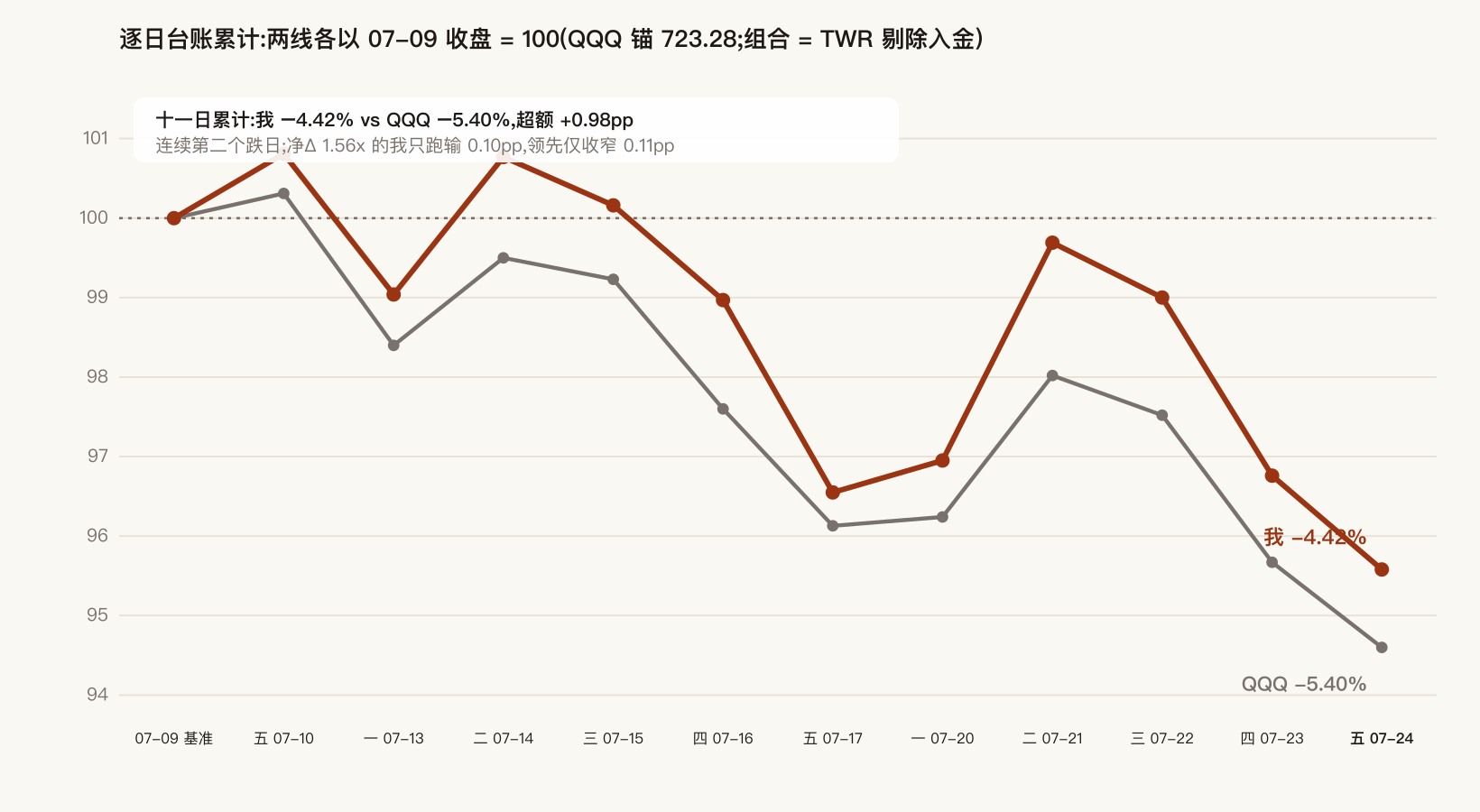
Since July 9: me −4.42%, QQQ −5.40%, excess still +0.98pp.
One comparison worth noting: my net delta leverage is 1.56x. In theory, QQQ down 1.12% should have put me down about 1.75%. I was down 1.22%. That missing half point came back from the calls I'd sold.
2. Attribution: long side −3.94%, short side gave back +2.73%
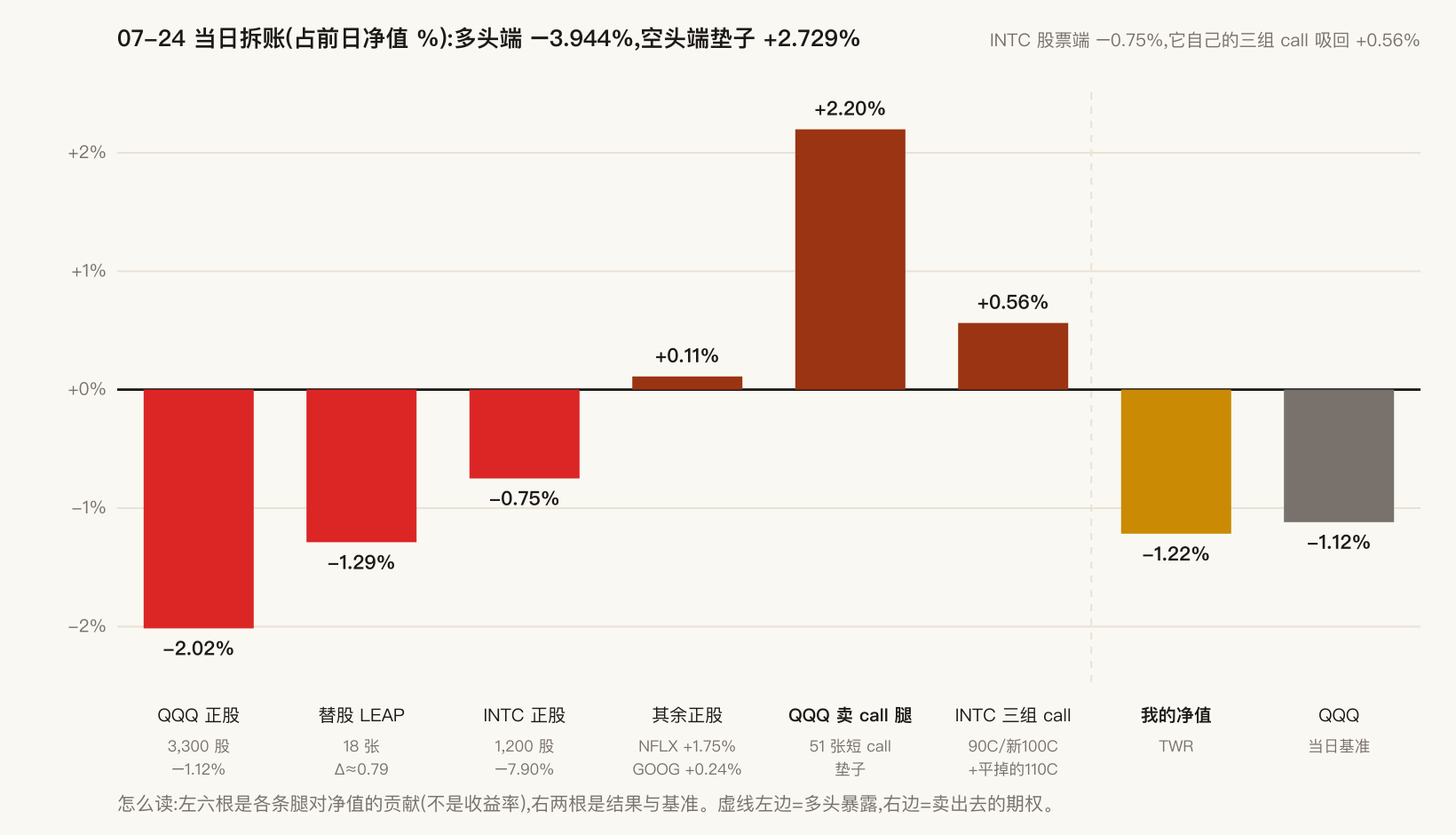
As a percentage of the prior day's net liquidation value:
| Leg | Contribution | Note |
|---|---|---|
| QQQ shares (3,300) | −2.02% | Index down 1.12%, I hold 180% of NLV |
| LEAP stock replacement (18 contracts) | −1.29% | delta ≈ 0.79, follows the index down |
| INTC shares (1,200) | −0.75% | This one. Down 7.90% |
| NFLX + GOOG shares | +0.11% | One up 1.75%, one up 0.24% |
| QQQ short calls (51) | +2.20% | The cushion |
| INTC's three call groups | +0.56% | 90C, the new 100C, and the closed 110C |
| NFLX + GOOG calls | −0.03% | NFLX rose against the tape, so its call lost a bit |
| Total | −1.22% |
Long side −3.94%, short side +2.73%. The options I'd sold absorbed 69% of the damage on a day like this.
Look at INTC alone: the stock lost 9,498 dollars, and its own three call groups made 7,131 — three quarters absorbed. That's the entire point of covered calls: not to make you more, but to make days like this hurt less.
3. The formula's fourth day: the gap has a name
Over the previous three sessions I fitted an empirical formula in this series to predict "if the index drops x%, how much do my 51 short calls give back":
Plugging in −1.1185% for today: predicted +1.576%. Actual +2.197%. A gap of 0.621 percentage points.
This is the first time the formula was clearly wrong. So I ran a leg-level Taylor decomposition on those 51 calls, using the broker's native greeks at the July 23 close as the baseline:
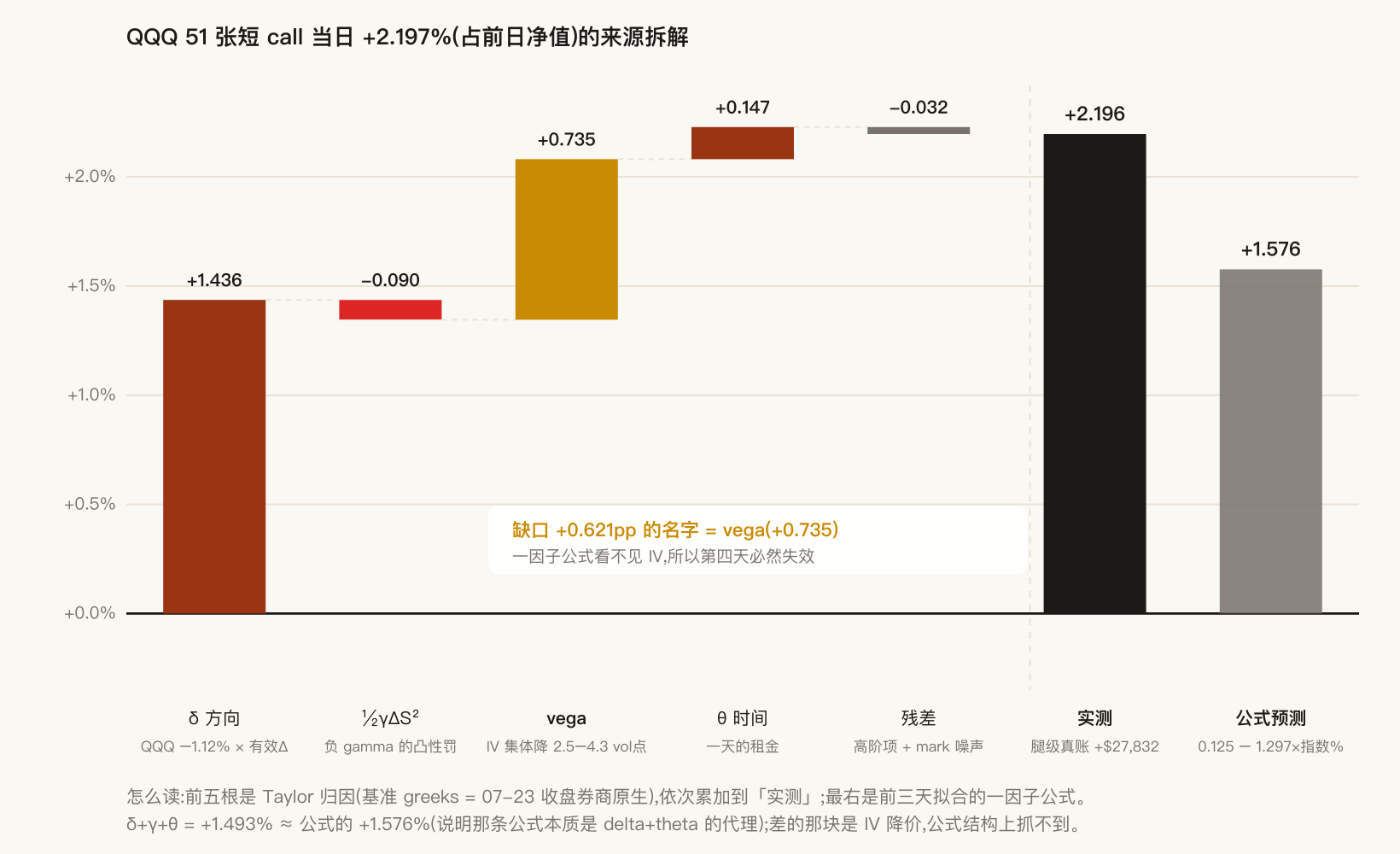
| Factor | Contribution | What it is |
|---|---|---|
| δ direction | +1.436% | QQQ down 1.12% × the book's effective delta |
| ½γΔS² | −0.090% | The convexity penalty of negative gamma |
| vega | +0.735% | Implied vol fell 2.5–4.3 vol points across the board |
| θ time | +0.147% | One day of rent |
| Residual | −0.032% | Higher-order terms + mark noise |
| Total | +2.197% | Leg-level actual: +27,832 dollars |
δ + γ + θ = +1.493%, almost exactly the formula's predicted +1.576%.
Which tells you what that formula really is: a proxy for delta plus theta. It's a one-factor model, and structurally it cannot see IV. The missing 0.62 points came entirely from volatility getting cheaper:
| Contract | IV yesterday | IV today |
|---|---|---|
| QQQ 650C 08-21 | 35.2% | 30.9% |
| QQQ 680C 08-21 | 30.1% | 26.9% |
| QQQ 700C 08-21 | 27.0% | 24.5% |
| QQQ 725C 08-21 | 23.2% | 21.4% |
The index fell, but fear got cheaper. That combination is uncommon — a falling tape usually comes with rising IV. The reason: yesterday's −1.90% candle (July 23) had bid the fear premium up to a high, and today the Dow actually closed green with the S&P roughly flat, so index option IV mean-reverted downward. I'm net short volatility, so I got paid twice: once because price fell (delta), once because fear got cheaper (vega).
But don't celebrate yet. That same IV decline cost my 18 long LEAP contracts 4,928 dollars of vega (32.1% → 30.3%). Net vega across the whole book is only +4,938 dollars — the short legs' +9,317 and the long legs' −4,928 largely cancel. This book isn't a pure short-vol machine; it's a hedged structure that sells vol on the short legs and buys it on the long ones, with thin net exposure.
The honest conclusion for this section: the formula isn't broken — I didn't give it enough factors. A one-factor model works in a one-factor tape; the moment two factors move together, it must fail. I'm not going to bolt an IV term onto it, because that would just be curve-fitting after the fact. The correct use is: compute the prediction, then treat the gap as a reading of what IV did today.
4. The only order I placed: pushing the cap down ten dollars
There was one forced decision today. My 10 INTC calls at the 110 strike expired today, and their price was down to 0.11 by the time I looked. Leave them alone and starting tomorrow 1,000 shares sit naked, collecting no overlay premium.
Within six minutes of the open I placed one order, cancelled it 16 seconds later, and replaced it with another:
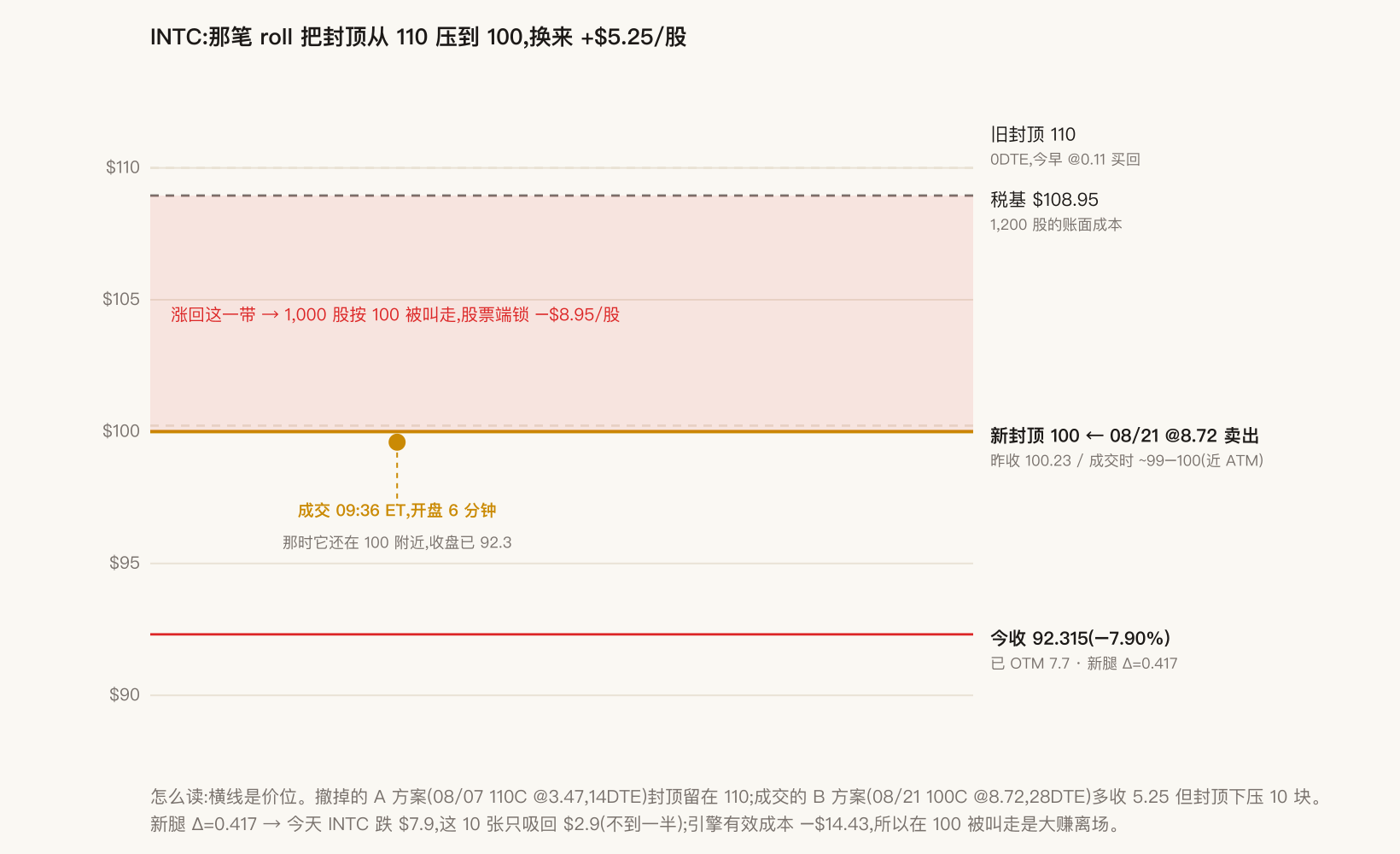
| Plan A (cancelled after 16 seconds) | Plan B (filled) | |
|---|---|---|
| What I sell | 110C expiring 08/07 | 100C expiring 08/21 |
| Credit | 3.47 per share | 8.72 per share |
| Days left | 14 | 28 |
| Upside capped at | 110 | 100 |
Buying back today's expiring 110C at 0.11 at the same time, the net credit was 8.61 per share, or 8,610 dollars.
Those 10 old 110C contracts were opened at 4.64 and closed at 0.11 — I kept 4.53, or 97.6% of the entry premium. That's the normal way a near-dated out-of-the-money short call ends. You don't need to wait for zero, because you want the overlay rolled forward in the same trade.
Both sides of this trade
The upside: at fill, INTC was still near 100, so I was selling a roughly at-the-money call. It closed at 92.32, leaving the call 7.7 dollars out of the money. Those 10 contracts marked up 2,945 dollars in the same session. Its extrinsic value is currently 5.775 per share, which by extrinsic ÷ spot × 365/28 works out to a nominal annualized yield of about 82%.
The cost side:
- I sold the upside below my own cost line. My tax basis is 108.95; the cap is now 100. If INTC climbs back above 100, 1,000 shares get called away at 100 and the stock leg locks in −8.95 per share.
- The downside is less than half covered. The new leg's delta is 0.417. INTC fell 7.9 dollars today and these 10 contracts absorbed 2.9. A covered call is not insurance; it's a thin cushion.
- That 82% is fake sustainability. It exists because IV is at 85% on post-earnings residue. Once IV normalizes, the same strike won't fetch that price. This number is one-off and must not be extrapolated into "this leg yields 82% a year."
So does point 1 count as a loss? Depends which ledger:
- Tax ledger: selling stock with a 108.95 basis at 100 books a loss.
- Economic ledger: since starting this program on May 7, the overlay has collected 123.38 dollars per share in premium, and the engine's effective cost basis is −14.43 dollars per share — negative.
A negative effective cost means the premium I've collected already exceeds what I paid for the shares. Getting called away at 100 isn't exiting at a loss; it's exiting with a large gain. Keep these two ledgers permanently separate — mixing them guarantees a wrong conclusion.
5. Why I didn't touch the other three
- QQQ: all 51 short calls expire August 21, 28 days out. Today's decline was itself collecting theta for me (giving back 27,842 dollars). No trigger condition at all.
- GOOG: the note I opened yesterday into that −7% candle is one day old, and the 7.9% cushion is still thick.
- NFLX: the only one of the four where the roll is running backward. It rose 1.75% against the tape to 70.095, so the 70C I sold just went in the money, the short leg's liability thickened, and the engine's effective cost rose from 73.19 to 73.58. Seven days to expiry — this is its decisive week.
There's also one thing I deliberately did not do: push the strike further down while INTC was panicking (selling a 95C for another notch of premium). That would mean selling the right to a rebound at the most fearful price of the day. No. Not acting is a decision too, and today it was worth more than acting.
6. State of the book
| Metric | Today | Yesterday |
|---|---|---|
| Gross leverage (shares + LEAP delta notional ÷ NLV) | 2.76x | 2.76x |
| Net delta leverage | 1.56x | 1.40x |
| Margin debt ÷ NLV | 1.07x | 1.07x |
| Distance to a margin call (zeroth-order, conservative) | 27.8% | 28.3% |
| Financing interest (% of NLV per year) | 4.56% | 4.53% |
| Portfolio net theta | +1,670 dollars/day | +5,102 dollars/day |
Three lines to watch:
- Net delta has climbed from 0.99 to 1.56 (four consecutive sessions). This is the mechanical consequence of negative gamma: as the market falls, the deltas of the calls I sold shrink, the hedge thins, and I automatically get longer into a decline. This is the single most important line in this book — more important than P&L.
- Net theta dropped from 5,102 to 1,670. Yesterday's figure was 65% one INTC 1DTE event leg (theta 3,341/day, inflated because gamma isn't modeled), and that leg is now closed. 1,670 is this book's real daily rent.
- Distance to a margin call is 27.8%, another 0.5pp closer than yesterday. The debt itself came down by 8,610 dollars, but NLV fell faster, so the ratio worsened. Financing costs 4.56%, already above the risk-free rate of roughly 3.6% — and 92% of my capital sits on the "stability note" side, whose funding cost now runs 0.96 percentage points above the risk-free yield. That's uncomfortable, and it's the thing in this book most in need of fixing.
7. Three things I learned today
First, good news earns no second reward. INTC is up roughly 170% year to date; the market walked into this print already expecting the turnaround to work. Revenue up 25% merely confirmed that expectation, while thin external demand in the foundry business, a meaningful capex increase next year, and an 11 billion dollar quarterly loss were not in the expectation. A stock that has already priced in good news falls when the good news is confirmed.
Second, when a model breaks, name the residual before you add parameters. That 0.62 points wasn't noise — it was vega. And knowing what it is means I don't need to stuff it into the formula, because next time two factors will move together again, and after IV there'd be a third. A one-factor formula's value isn't its accuracy; it's that when it's wrong, the gap itself is a reading.
Third, covered calls earn their keep in falling markets, not rising ones. Today the long side lost 3.94% and the short side gave back 2.73%, so a position with 1.56x net delta trailed the index by just 0.10 percentage points. That isn't alpha; it's shock absorption bought by giving up upside. The next rally it will bite me instead — that's the other half of the same trade, not a surprise.
All data comes from the broker's authoritative API (Robinhood MCP) plus a local quant.db load; greeks are the broker's server-side values, and returns are always TWR with deposits excluded. Dollar amounts are converted to percentages where anonymization requires it; effective cost, leverage, and margin distance are engine outputs, not hand calculations.