WRITING
The Name That Fell the Most Didn't Cost Me a Cent

All three names I hold fell today. The biggest drop was INTC, down 1.24%; the smallest was QQQ, down only 0.37%.
And 100.3% of the day's loss came from QQQ alone. More than 100, because INTC and GOOG together netted a positive 0.16 basis points.
The ranking is completely inverted. I'm writing this day up on its own because it took something I thought I already understood and, for the first time, laid it out in a shape I could just look at.
1. Two rankings, pointing opposite ways
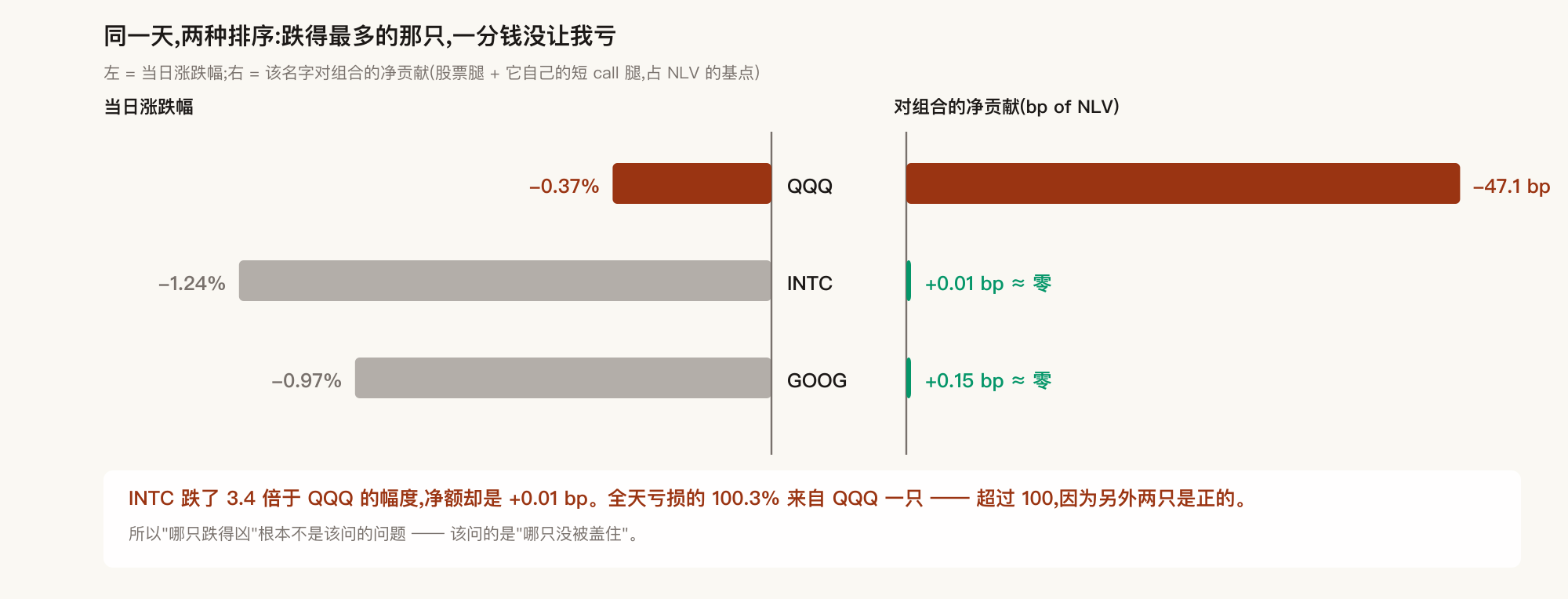
On the left is the day's percentage move. On the right is each name together with the calls I've sold on top of it, as a net contribution to the whole portfolio.
- INTC fell 3.4× as far as QQQ, and netted +0.01 basis points.
- GOOG fell 2.6× as far, and netted +0.15 basis points.
- QQQ fell the least, and netted −47.1 basis points.
The stock leg of INTC did lose money, but the 12 calls I have pressed on top of it were falling at the same time — I'm the seller of those calls, so their falling is my gain. Subtract one from the other and it almost exactly cancels. Same with GOOG.
This isn't luck. This is design.
2. The answer isn't in the drop, it's in the coverage ratio
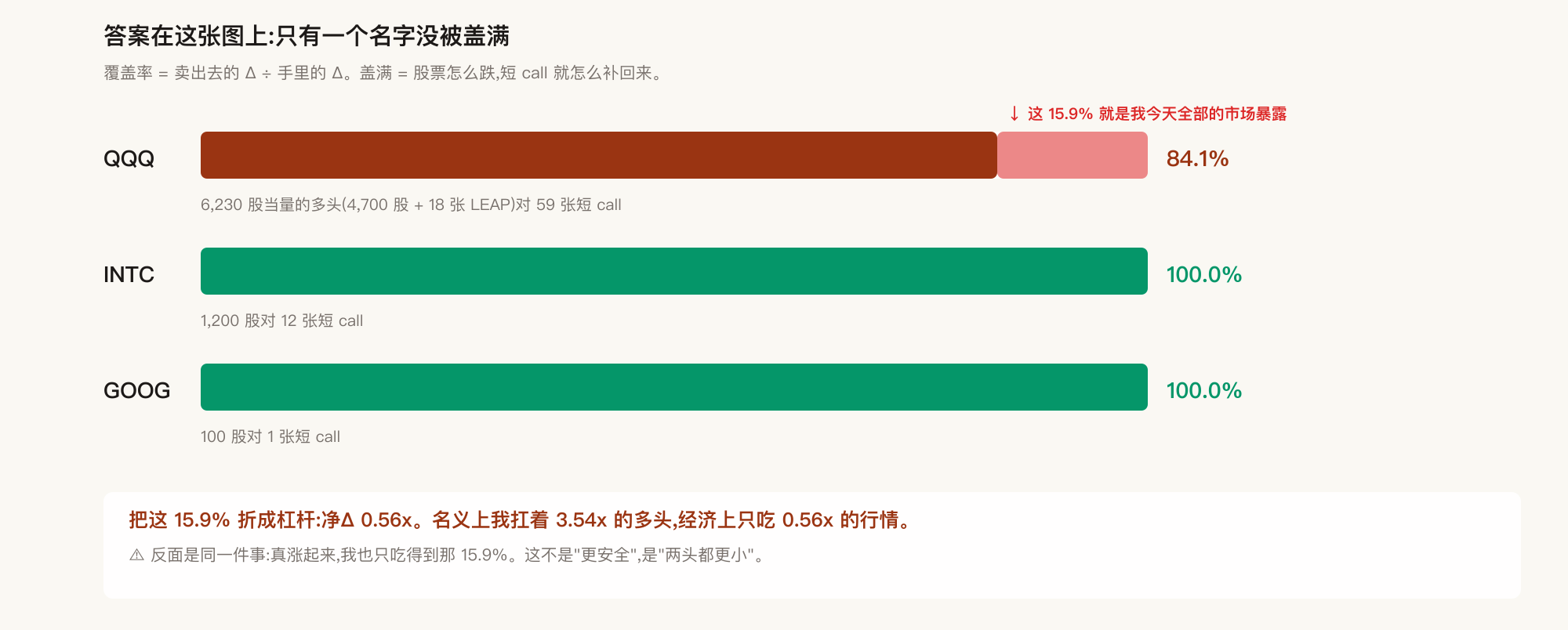
Coverage ratio = the exposure I've sold ÷ the exposure I hold. Fully covered, and however far the stock falls, the calls make it back for me.
- INTC: 1,200 shares, 12 calls pressed on top. 100%.
- GOOG: 100 shares, 1 call. 100%.
- QQQ: 4,700 shares plus 18 long-dated calls converted to 1,530 share-equivalents, for 6,230 share-equivalents of long exposure, against only 59 calls on the other side. 84.1%.
That remaining 15.9% is my entire market exposure today. Converted to leverage that's 0.56× — nominally I'm carrying a 3.54× long position, economically I only take 0.56× of the move.
So "which one fell hardest" is simply not the question to ask. The question is: which one isn't covered.
Stated the other way it's the same fact, and this side is the one worth remembering: when it really rallies, I only get that same 15.9%. That isn't "safer," that's smaller on both ends. The downside protection is bought by selling the upside; the books are symmetric, and there's no free side.
3. One more thing flipped sign today
Yesterday I wrote an ugly review: the margin buffer fell from 49.43% to 37.56%, breaking below the 40% survival line I drew for myself for the first time — and going through the books, what broke it was my own three add-on actions, 87% of it.
Today the buffer slipped a bit further, 37.56% to 37.29%. But broken apart, the character of it is completely different.
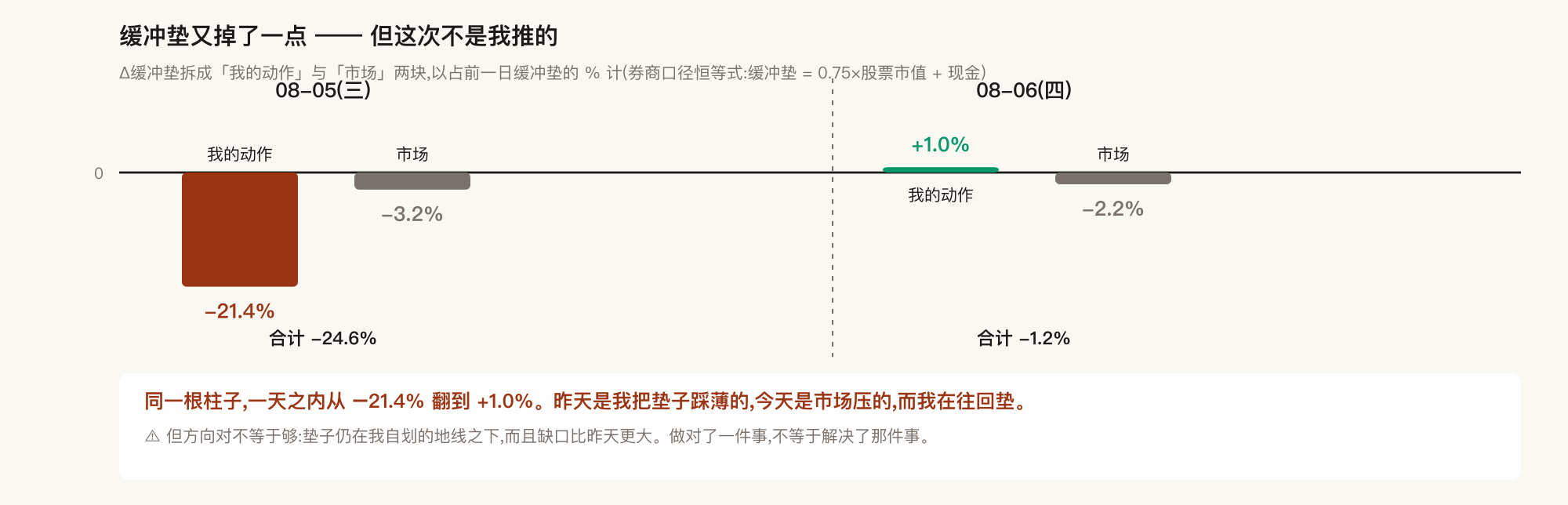
The broker computes the buffer with one identity: buffer = 0.75 × stock market value + cash. The net market value of the options goes in and out of both the maintenance requirement and the equity, and cancels entirely. So a day's change in the buffer can only come from two places: stocks moving, and cash moving.
- Yesterday: my actions −21.4% (exercise-driven stock purchase, overnight stock purchase, net debit on directional trades), market −3.2%.
- Today: my actions +1.0% (the cash from the calls sold at the open went straight to paying down debt), market −2.2%.
The same bar went from −21.4% to +1.0% inside a single day.
But right direction doesn't mean enough. The buffer is still below the line I drew myself, and the gap is wider than yesterday's. Doing one thing right isn't the same as solving that thing — I have to write both of those sentences down; writing only the first one is self-congratulation.
4. What I most owe an account of today is the thing I didn't do
There were only two trades all day, both done within one minute of the open, and then six and a half hours of not touching anything.
The two I did: bought back a leftover same-day-expiry call from yesterday for five cents to close it out, and pushed it to next week; then, against the 600 shares that came in from last night's exercise and assignment, wrote 6 calls expiring next Friday on the spot, collecting 7.28.
The second one is worth a line of its own: those 600 shares came from the long leg of a spread from last week being exercised. The shares land in the account and immediately become collateral for a new note — there was no "buy back the old leg, then sell a new one" roll anywhere in there, and I paid the sell-side spread exactly once. Not one step in the whole chain was forced.
The thing I didn't do is today's real account.
The rule I set for myself is clear: with the buffer below 40%, the day's position-opening allowance is zero, and the direction is "reduce," not "don't add." The allowance the engine gave today was zero contracts, for the second day running.
For the second day running, I didn't reduce.
I can list the reasons myself: the liquidation point isn't anywhere near (repricing leg by leg, QQQ has to fall 19.3% before the buffer goes to zero); today's move was a shallow pullback driven by long-end rates, not a trend break; and cutting on a day that's only down 0.37% is the most expensive way to delever.
Every one of those reasons holds. The problem is that they are overriding a gate I set myself, and that gate exists precisely to stop me from talking myself around at moments like this.
So I'm booking it explicitly: this is a deliberate exception, not an oversight. And the price is priced: if Friday's jobs report pushes the long end higher and QQQ drops another 1.5%, the buffer goes to around 35.5%. At that point it stops being a choice.
One more thing I didn't do today, while I'm at it: I didn't touch directional trades again. The money the three bull call spreads lost yesterday was money spent buying a direction — a bull call spread is a bet on direction, not rent collection. Second down day in a row, buffer still below the line — opening a directional trade at a moment like that is spending the risk budget on emotion. Not opening one is discipline, not hesitation.
5. Scoreboard
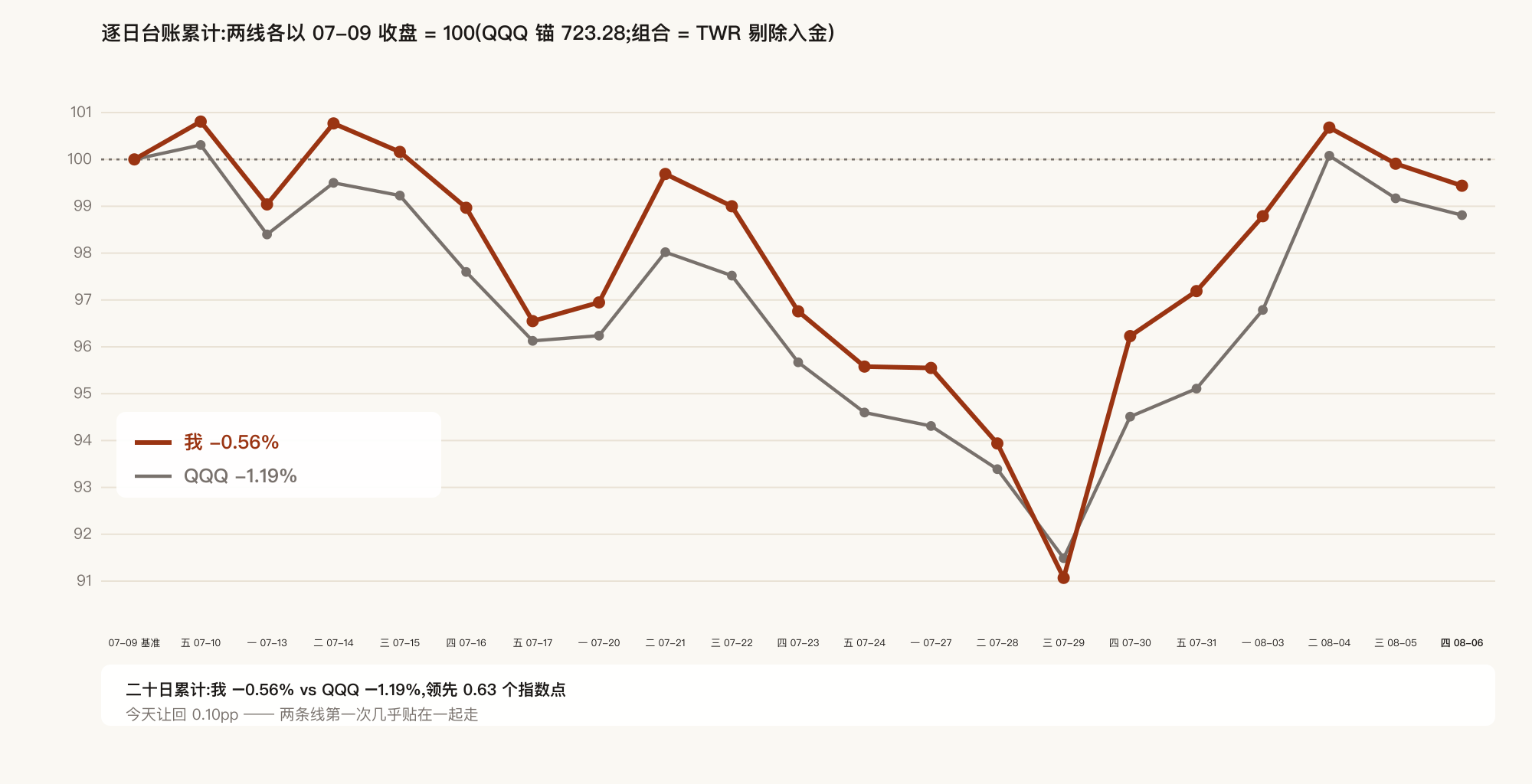
Today I gave back 0.10 percentage points: me −0.47%, QQQ −0.37%. Twenty-day cumulative, I'm −0.56% and QQQ is −1.19%, still ahead by 0.63 index points, a bit thinner than yesterday's 0.74.
What's interesting is where that 0.10 points came from. On the broker's first-order delta, for QQQ's $2.65 drop, my deep in-the-money calls should have given back more than they actually did — they didn't fall enough. In a falling tape volatility didn't collapse, so the time value refused to come out. On top of that, the 7 I sold in the morning went off at the intraday low (QQQ briefly broke the 50-day moving average early and got bought back up), so their same-day mark is negative.
Neither of those is a mistake. The first is volatility not cooperating, which I don't control; the second is the cost side of the discipline that says "sell after it falls, sell at the moment volatility is expensive" — it earns its money on expiration day, not on the day itself. As long as I don't go touch it just because the same-day number looks bad, that account is still on track.
Not one dollar of today's loss came from a bad judgment. All of it came from "I hold these things, and these things fell today."
Days like this are the least interesting to write up, and the most necessary. Because it exposed something the market usually covers over: the real variable in this playbook was never "did it go up or down today," it's "how much of it isn't covered."
And that number, today, is 15.9%.