WRITING
I Spent More Than Half of Last Night's Free Safety Cushion the Same Day

Yesterday's 30 points of safety cushion weren't earned by me; today's 21 points of spending are the decision I actually made. The two happened less than twenty hours apart, in exactly opposite directions, and only added together do they look like one complete rule actually running.
First let me square the books. After yesterday's (Thursday's) close, all 25 of my short calls were assigned, 2,500 shares were delivered away at the strike, and a $1.57M margin debt shrank overnight to under $80K. The margin buffer — the number that gets you force-liquidated when it hits 0 — sprang from 37.45% to 68.06%. Those 30.6 percentage points, I didn't move a finger for. The expiration date walked it out by itself.
Within the first three hours of today's (Friday's) session, I made nine manual trades and spent 20.9 of those points.
1. What buttons did I actually press
Nine trades are really the same action repeated four and a half times:
| Time (ET) | Action |
|---|---|
| 09:40 | Sold 1 QQQ 675C (8/21 expiry) |
| 10:03 | Bought 500 shares of QQQ + sold 5 665C |
| 10:32 | Bought 500 shares of QQQ + sold 5 665C |
| 10:59 | Bought 400 shares of QQQ + sold 4 670C |
| 11:08 | Bought 500 shares of QQQ + sold 5 665C |
The stock orders and the call orders were all less than 20 seconds apart. That isn't a coincidence, it's discipline: I leave no naked-long window. The instant the shares came in, the upside above was already sold, and I give myself no room in between for "should I wait a bit before selling" — because once you leave that room, you start timing, and timing is something I've already sentenced to death by backtest.
By the end of the day: QQQ holdings 1,500 → 3,400 shares, cash debt from −$79K back to −$1.32M, margin buffer landing at 47.18%.
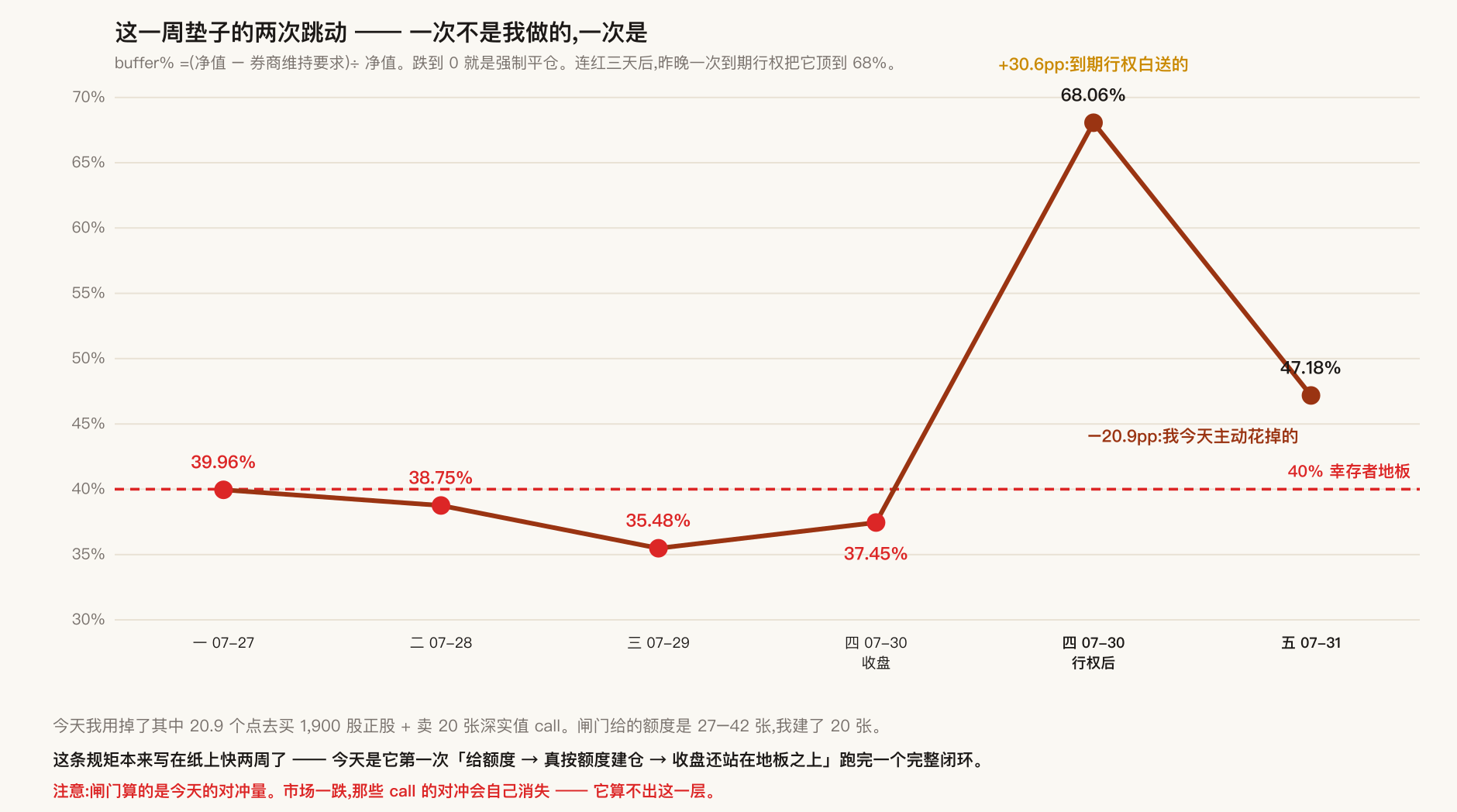
What deserves attention in this chart isn't the peak, it's the difference in nature on either side of it. The leap on the left was walked out by the rules themselves; the drop on the right was pressed out by me. It's very easy to count the former as your own skill too — net worth went up, the red flags cleared, the book is all green. But the three buttons I pressed that day added up to a loss.
2. This rule was written two weeks ago, and today was the first time it really ran once through
My position-building allowance isn't a guess, it's a formula:
40% is the survival floor I drew for myself. Only the part above the floor is money that can be taken out and turned into positions.
This formula went into the ledger in mid-July, but before today it had never actually "given" me anything — because the buffer sat below 40% three days running, the numerator was 0, and the allowance was 0 contracts. A rule that always outputs 0 and no rule at all are behaviorally indistinguishable.
Last night the buffer jumped to 68.06% and it produced a positive number for the first time: 27 to 42 contracts (depending on how deep a strike you sell). Today I built 20 contracts, closing buffer 47.18%, standing 7.2 points above the floor.
Allowance issued → position built to the allowance → still above the floor at the close. That's the first time it has run a full loop.
I'm pulling this out separately not because the number 20 matters, but because a rule is either running or it's on paper, and there is no third state. It lay on paper for two weeks and I had no idea whether it was usable — not until today, when it really did constrain my hand, did I know it was alive.
While I'm at it, here's its known blind spot, so you don't treat it as gospel: this formula computes today's hedge. My 52 short calls are providing a great deal of hedging right now, but the moment the market falls, that hedge disappears on its own (the calls go out of the money, delta collapses) and the portfolio automatically reverts to something close to fully long stock. July 29 already staged this once: I did nothing at all, and net exposure ran from 1.46x to 2.01x by itself. The formula can't compute that layer. What it gives is a snapshot of today, not a promise in a falling market.
3. The strike turn: today I did the exact opposite of the past four days
This is today's real decision, and it matters far more than "how much leverage I added."
Over the past four days, every note I built had its strike pushed lower: 630 → 610 → 600 → 625. The lower it goes, the thicker the safety cushion (breakeven 10% to 13% below spot), and the price is coupon yield sliding all the way from 18% down to 12% annualized.
Today's four trades jumped back to 665 and 670 in one go. The safety cushion is down to 4.3% to 5.0%, and the annualized coupon jumps to 26.7% to 30.9%.
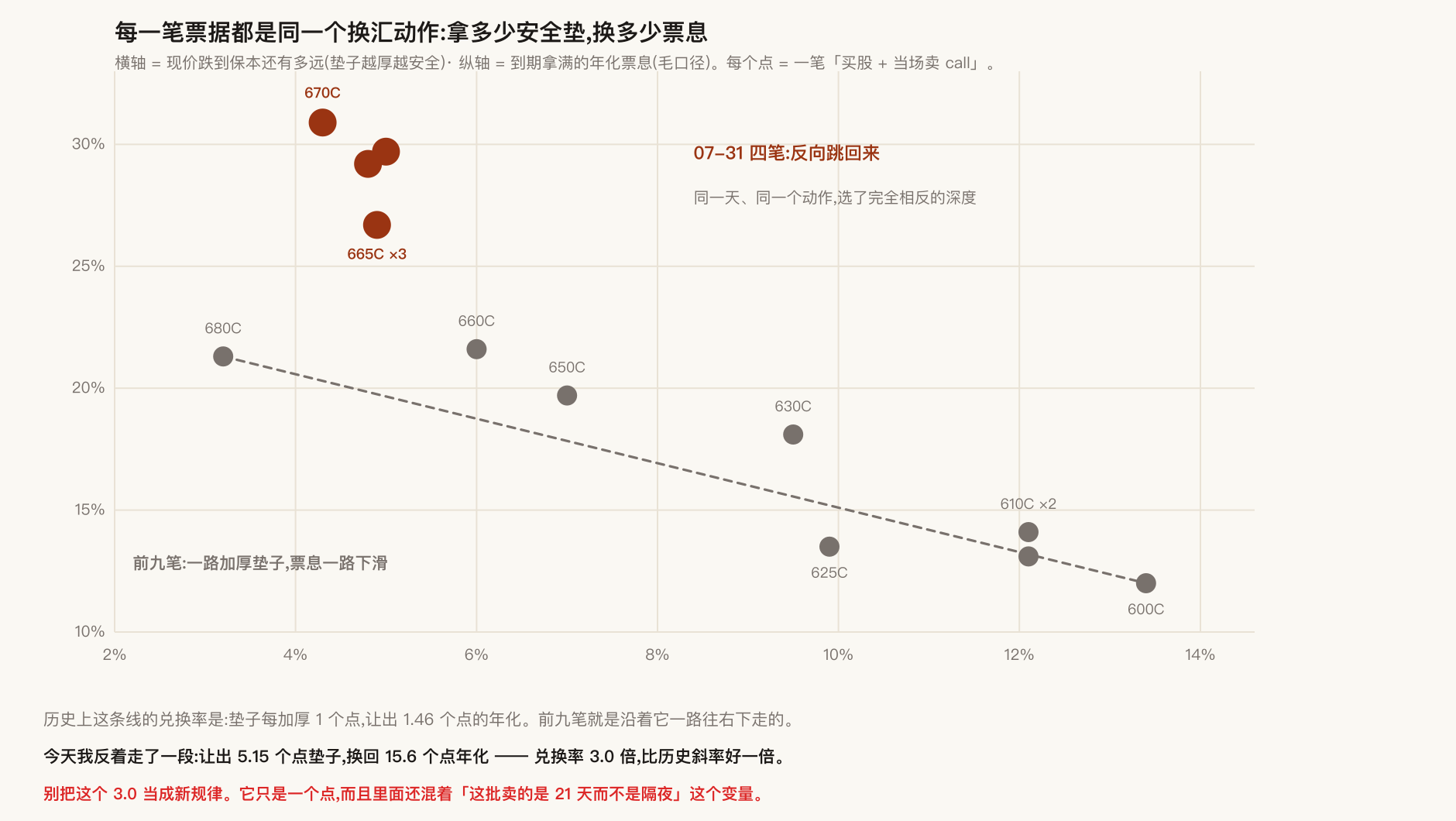
Historically the exchange rate on this line has been stable: every extra point of cushion gives up 1.46 points of annualized yield. The first nine trades slid down and to the right along that line. Today I walked a stretch of it backwards: gave up 5.15 points of cushion and got back 15.6 points of annualized yield — an exchange rate of 3.0x, twice as good as the historical slope.
The reason it's twice as good isn't all in the strike. What I sold today was 21 days to expiry, while several of the past few days' trades were overnight and near-month. Time value itself is thicker. So don't take 3.0 as a new slope and extrapolate from it — it's a single point, and it has two variables mixed inside it.
So why turn today? Because when the cushion is thick you should do the aggressive thing, and when the cushion is thin you should do the conservative thing. Last night the buffer surged to 68%, the thickest it has been in over a month; to keep buying 600-strike "QQQ has to fall 13% before I lose principal" ultra-conservative notes at a moment like that is holding a strong hand and not playing it.
I'll put the cost in plain sight: these 20 contracts cover 2,000 shares, and QQQ only has to fall to around 654 before they start eating into principal — whereas the 625 batch would have to fall to 620. Both go by the name "selling calls for rent," and the risk sits at twice the distance.
4. The name that rose the most today earned me not one extra cent
Google was up 6.90% today, the strongest name in my book. Its cloud business grew 82% year over year in Q2, and diluted EPS jumped from $2.31 a year ago to $9.11 — the market is finally willing to believe the money shoveled into AI infrastructure can turn into revenue.
I hold 100 shares. It made $23.03 a share for me.
Then the 300-strike call I sold eight days ago went from 35.70 to 57.83 in step, eating $22.13 a share.
Net: $0.90 left. 96% of the move went into the pocket of whoever bought that call.
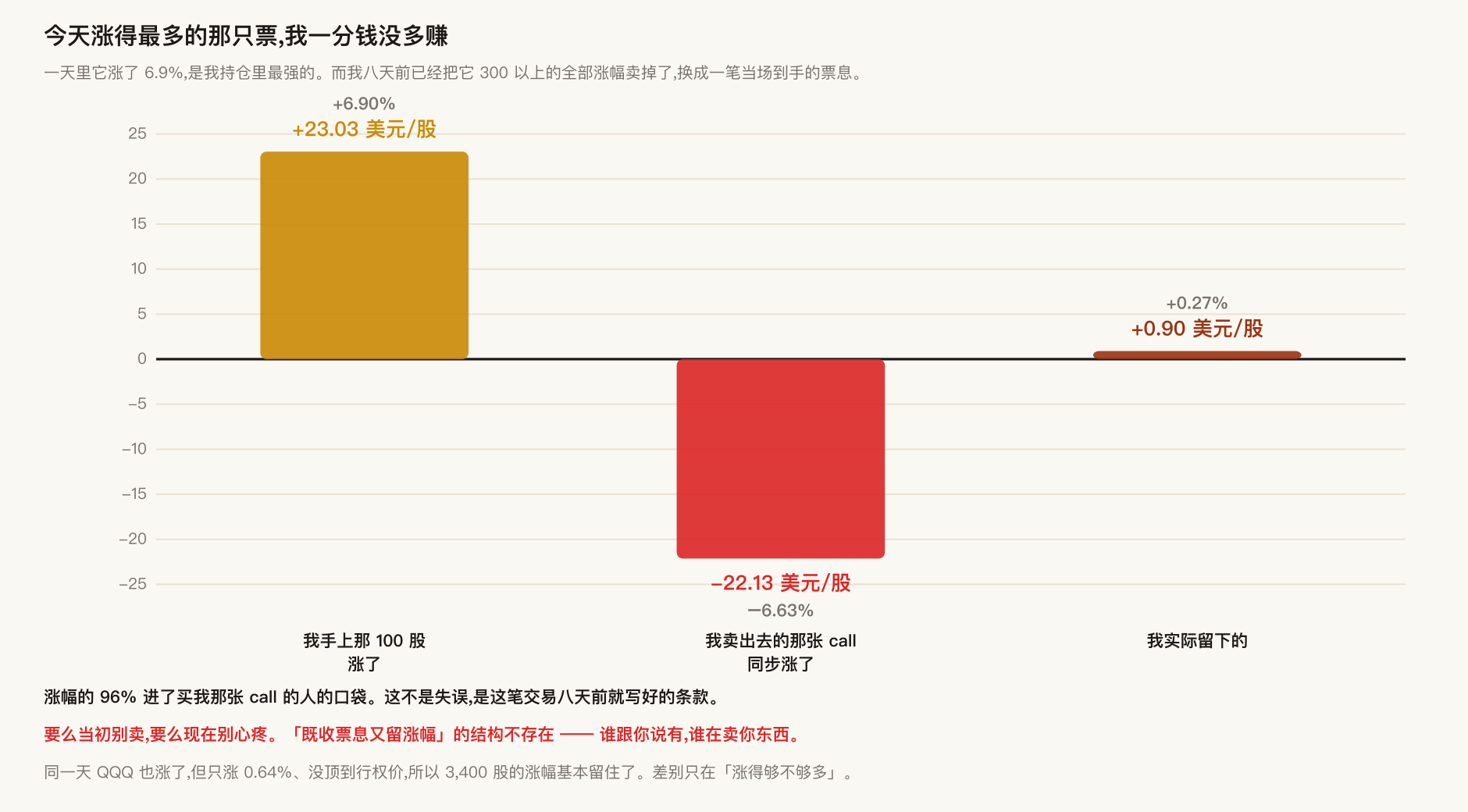
This isn't a mistake. It's the clause I signed voluntarily eight days ago: trade all of Google's upside above $300 for a coupon collected on the spot, mine to keep whether it rises or falls. Today it paid out — and what paid out was the half I didn't want.
I know some people reading this will say, "See, selling calls means you get left behind." Yes, it does. But a structure that collects the coupon and keeps the upside doesn't exist — whoever tells you it does is selling you something. Either you don't sell it in the first place, or you don't feel sorry about it now; the one thing you can't do is demand after the fact something you didn't pay for at the time.
QQQ went up the same day too, only 0.64%, never reaching the strike, so the gain on 3,400 shares was basically kept. Same structure, same day, one got hurt and one didn't — the only difference is whether the move was big enough. This structure is friendly to small gains and unfriendly to spikes. That simple, no second layer of explanation.
5. One more thing: the relief of being assigned away
Tonight my 11 Netflix 70-strike calls expire, all in the money, and 1,100 shares get delivered away at $70. This position goes to zero.
On the books it's a loss: cost 73.13, sold at 70, plus the 0.89 coupon collected, effective sale price 70.89, a realized loss of 3.06%.
But I'm not going to package it as a mistake to beat myself up over, and I'm not going to package it as a victory either. It's an exit that was set three weeks ago.
Netflix is down 26% this year and down 48% over one year, with revenue growth falling quarter after quarter: 17.6% → 16.2% → 13.4% → management's guidance for the current quarter is only 11.7%. Holding a name like this, the hard part was never judging whether it's worth it — it's making decisions while it's falling. Every single day you ask yourself "should I cut it" and "is it near the bottom," and on the way down neither of those questions can be answered correctly.
When I sold that 70C on July 20, I outsourced the decision to the contract itself: if it's above 70 at expiry, I'm out. Today it's at 71.70, so I'm out. I made no judgment today at all.
The most valuable thing about the note structure isn't the coupon, it's that the exit rule is written on the day you open the position. Whether you collect 15% or 20% annualized is a matter of the books; not having to decide on the fly in a falling market is a matter of psychology. I believe the latter contributes more to long-run results than the former.
6. The scoreboard
| Date | Me (TWR) | QQQ | Excess |
|---|---|---|---|
| 7/29 (Wed) | −3.06% | −2.03% | −1.03pp |
| 7/30 (Thu) | +5.67% | +3.30% | +2.38pp |
| 7/31 (Fri) | +1.00% | +0.64% | +0.36pp |
| 16-day cumulative | −2.81% | −4.89% | +2.08pp |
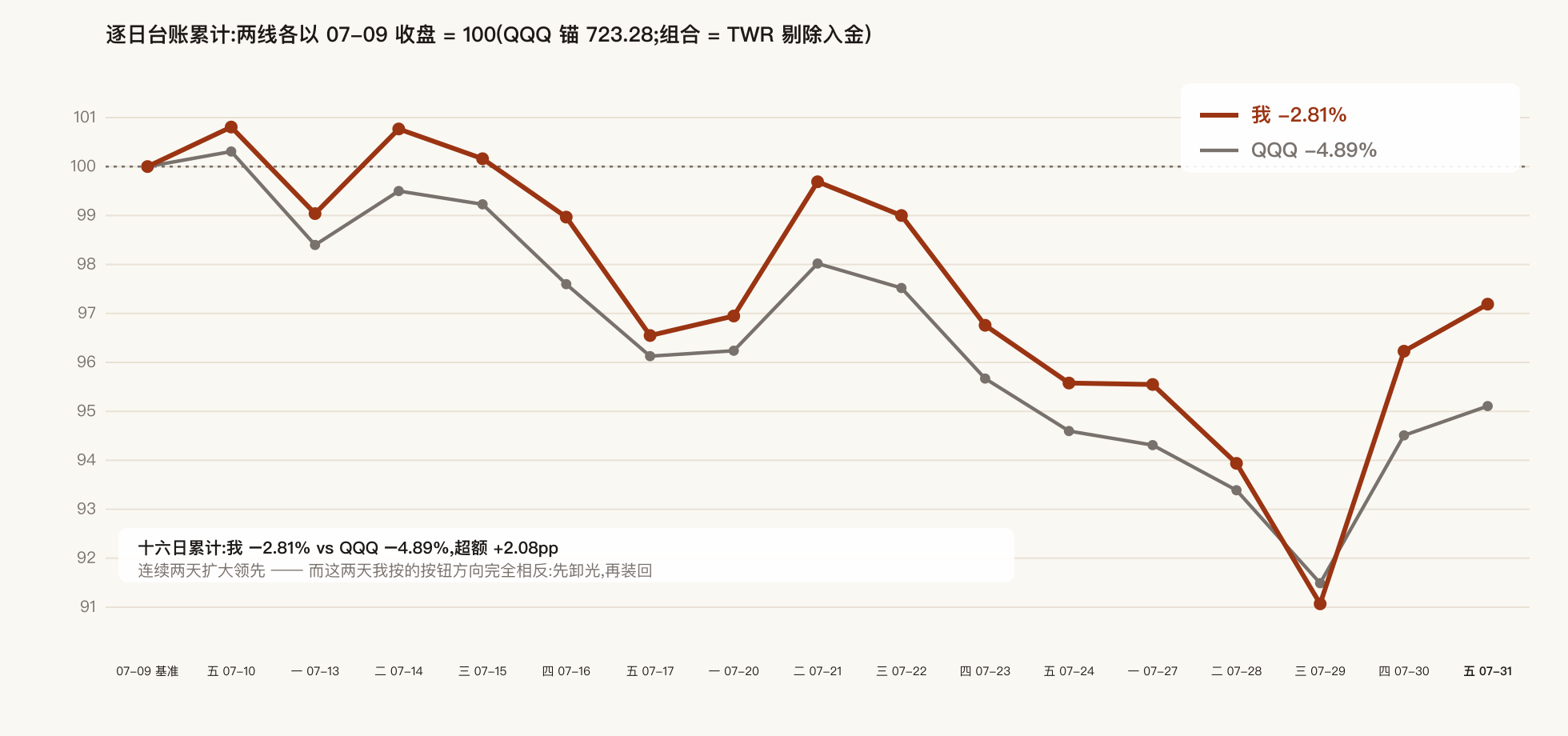
Two days in a row of widening the lead. And on those two days the buttons I pressed point in exactly opposite directions: Thursday I did nothing (more precisely, the three trades I did make added up to a loss), Friday I made nine heavy position moves.
Which is exactly what shows that neither day's excess came from my judgment that day. Thursday's 2.38 points came from structure (leverage from long-dated options + only 12 calls written against Intel), and Friday's 0.36 points came from the holdings themselves. The 1,900 shares I bought today contributed under six thousand dollars — against twelve thousand of total gain for the day, that's a rounding item.
7. The risk I didn't price today
Finally, one thing that showed up nowhere in today's prices but that I consider the most important.
On the same day, the 30-year U.S. Treasury yield rose to its highest level since 2007, and the 10-year is above 4.7%. The reason is that the market no longer buys the Fed chair's resolve to suppress inflation.
And I'm now $1.24M net in debt, with 184% of the position riding on a growth-stock container.
My financing rate is tied to the short end (4.25%), so when the long end rises my monthly bill doesn't change immediately. But long-end rates are the gravity of valuation multiples — as they keep climbing, what they press down on is the ceiling of this whole basket of mine. Today the Nasdaq's record close and the nineteen-year high in long bonds happened at the same time, and on the statements those two things don't contradict each other: nominal growth is strong, inflation expectations are sticky, and stocks and bonds are being repriced by the same force.
The only reason I can still keep ignoring it today is that the buffer still has 47%.
If that number ever falls back below 40%, the first thing to reread isn't my positions, it's this section.
Numbers come from a real brokerage account (Robinhood) on that day's closing basis, not a simulation. Amounts are presented in percentage or per-share terms throughout. This is a public exercise in self-accounting and does not constitute investment advice — least of all, don't copy the leverage.