WRITING
A Quiet Red Day Runs the Formula Backward — Plus: Intel Reports Tomorrow, Here's How My 1,200 Shares Are Positioned

U.S. stocks pulled back modestly today. QQQ closed at 705.35, down 0.51%; my book, on a time-weighted basis (TWR, deposits removed), fell 0.69% — underperforming the index by 0.18 points. No trades. Nothing placed.
First, why the tape fell: not tech fundamentals, but an oil shock plus pre-earnings caution. Brent crude jumped 3.4% to $94 — a one-month high — on the 11th round of U.S. strikes against Iran, and gold caught a safe-haven bid to a two-week high. Alphabet and Tesla both reported after today's close, so the market drifted lower on light volume waiting for them (both then disappointed after hours — GOOGL −5% on raised capex, Tesla a miss). Under the surface, software led the decline while chips actually rebounded, so my long side's loss was mostly QQQ index beta, not a semiconductor rout. On single names: Intel reports after the close tomorrow (detailed in section 4), and Netflix popped 2.2% intraday on a record $4.7B buyback but the broken-chart trend is intact.
What's worth writing down isn't the 0.69%. It's this: the straight-line formula I drew in yesterday's post ("the index jumped, I rose more") got run today on its other side — and every sign flipped.
1. Attribution: the cushion flips to a gain
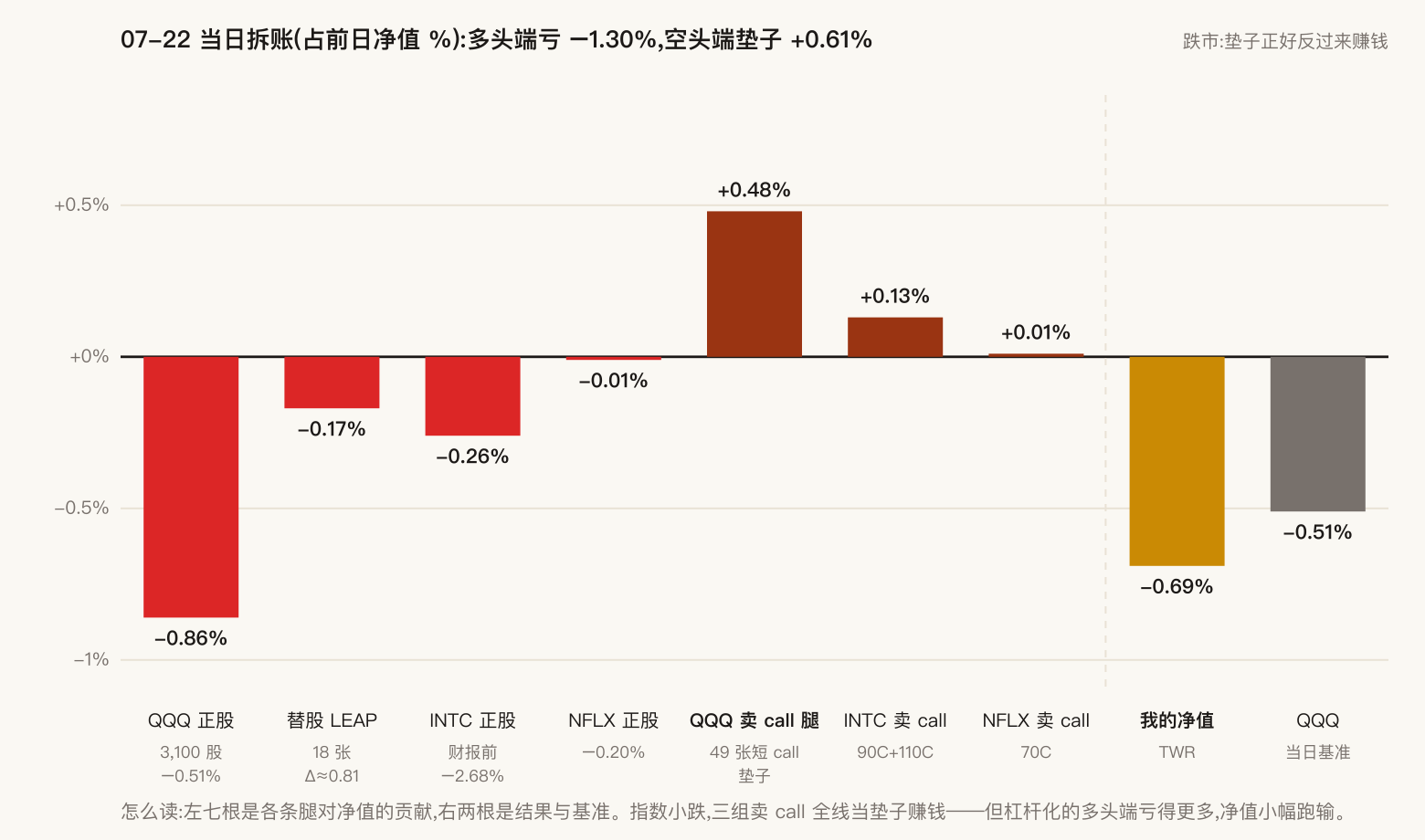
Yesterday the index surged, and the sold calls were the drag (−2.41%) while the leveraged long side earned more, so net value outperformed. Today it fell, and everything mirrors:
- Long side loses −1.30%: QQQ shares −0.86%, the stock-replacement LEAPS −0.17%, Intel shares −0.26% (pre-earnings fade), Netflix shares −0.01%.
- Short side cushions +0.61%: all three sold-call books made money — the 49 QQQ short calls +0.48%, Intel's 90/110 calls +0.13%, Netflix's 70 call +0.01%.
Net: −0.69%. The reason I trailed the index by 0.18pp is plain: my long side is leveraged (net long > 1×), so it loses more than the naked index on a down day; the call cushion only recovers part of it. That's exactly how this strategy prices — earn more on up days, lose a touch more on down days, and grind the volatility flat with call premium.
2. Breathing leverage: what I melted off yesterday grew back today
Yesterday I wrote that this book's net-long exposure breathes automatically — on rallies, the short calls' deltas rise together and "melt" my net long (from 1.31× down to 0.99×). Today the index dipped and the same machine ran once in reverse:
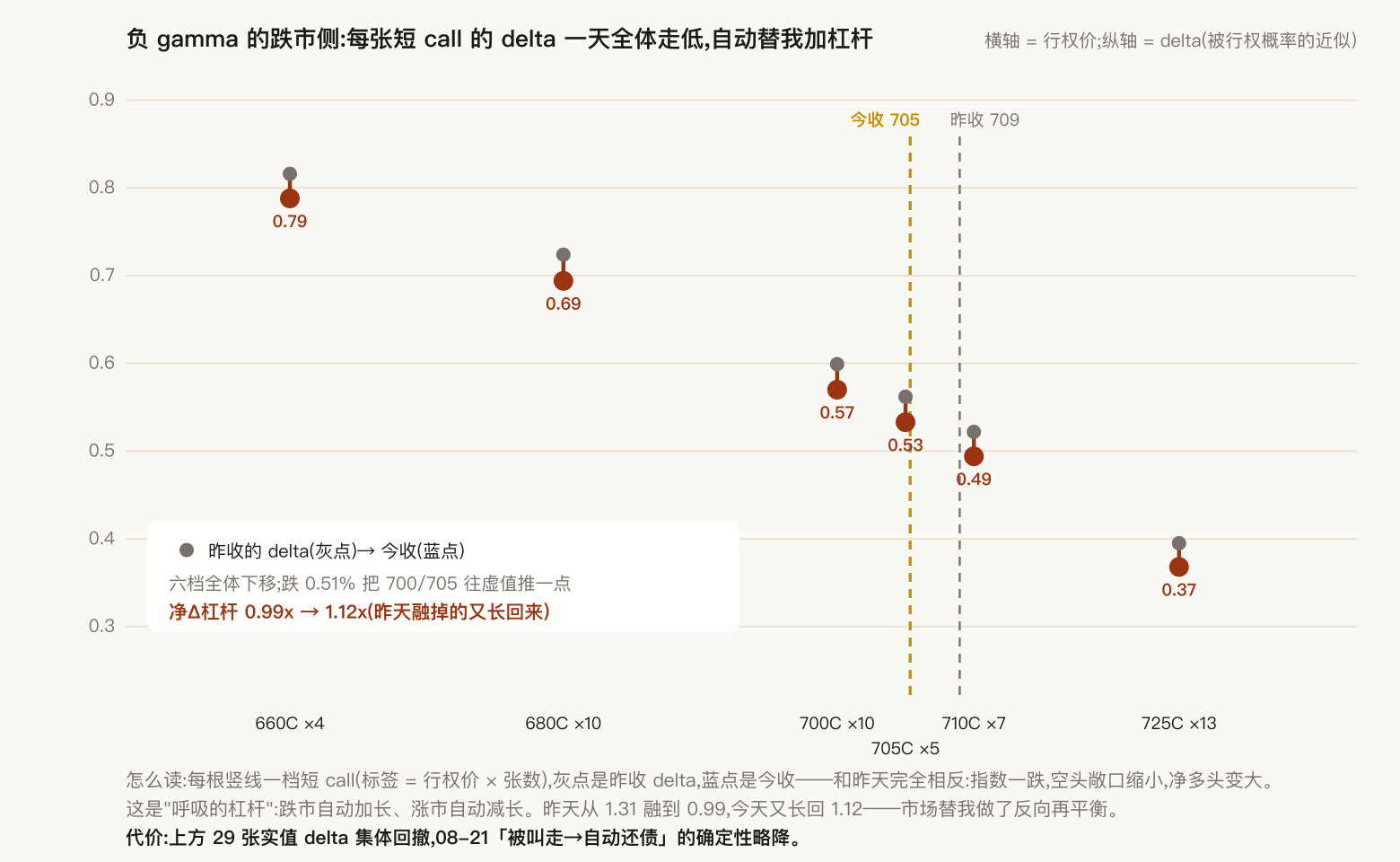
The six QQQ short-call deltas all stepped down in a day (grey → blue dots), and net-long leverage grew back from 0.99× to 1.12×. The mechanism is the strict opposite of yesterday: the index falls, the short calls retreat toward out-of-the-money, the short-direction exposure shrinks, and what's left as net long gets bigger.
This is the two-sidedness of "negative gamma":
Yesterday plugging in +1.855% → the formula predicted the short-call leg at −2.28%, actual −2.41%, residual 0.13pp (gamma made the loss slightly steeper). Today plugging in −0.51% → the formula predicts +0.79%, actual QQQ short-call leg +0.48%.
Direction dead-on; magnitude off by 0.3pp this time — and the direction of that miss is itself gamma's signature: on a down day the short calls shed delta as they fall, so they earn less than a linear extrapolation from yesterday's deltas would say. On the up day gamma made the loss steeper; on the down day gamma makes the gain duller — one second-order term, taking a bite from each side in its own way. The straight line is only a first-order approximation; the second-order gamma is always alongside, correcting it.
One cost worth logging: the 29 in-the-money calls overhead pulled their deltas back a notch today, so the certainty of that Aug-21 "rally through → get called away → auto-deleverage" channel loosened by one click.
3. Scoreboard
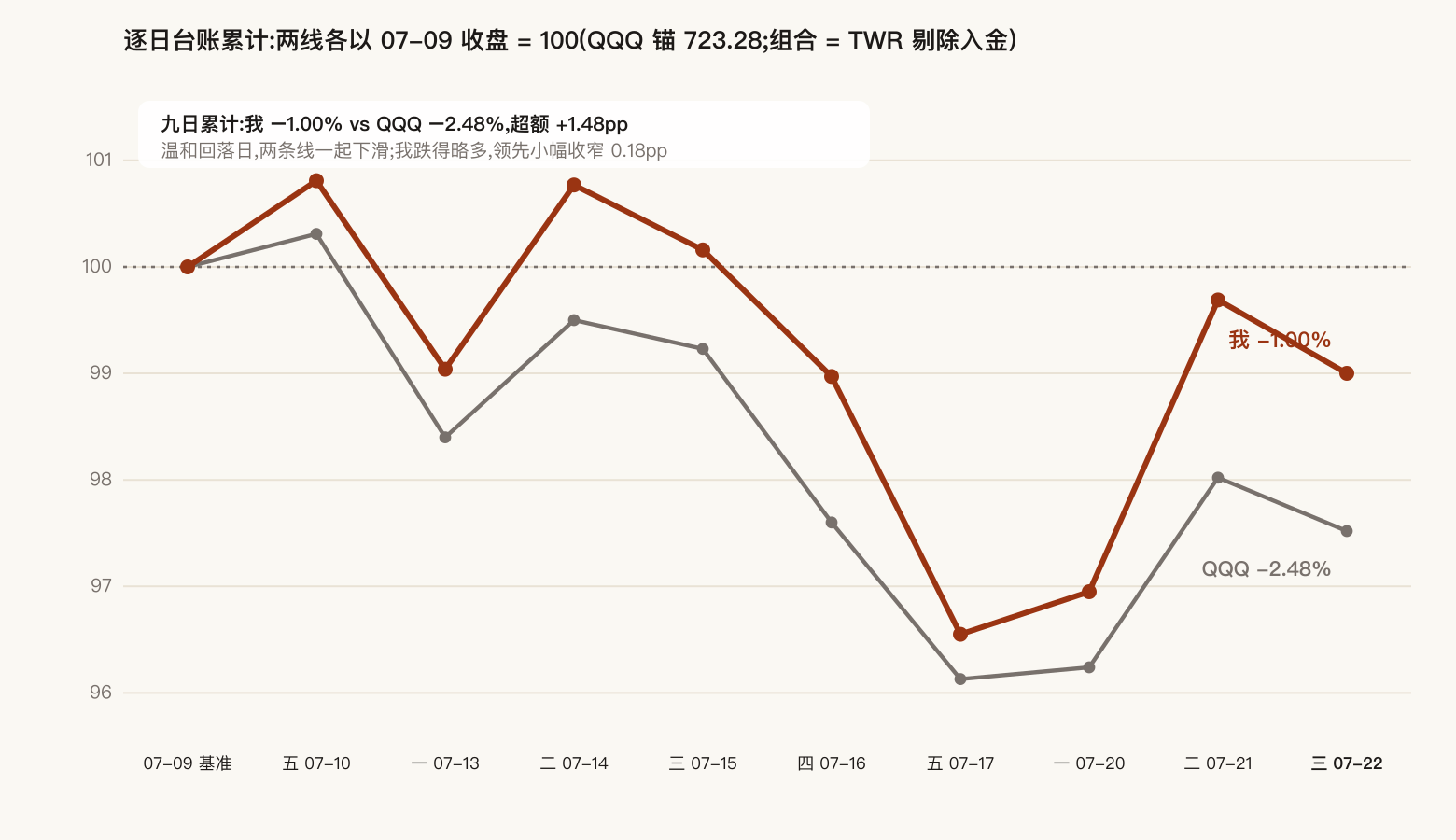
Cumulative lines indexed to July 9 close = 100: me −1.00% vs QQQ −2.48%, excess +1.48pp. Both lines slid today; I fell a bit more, so the lead narrowed from yesterday's +1.66pp to +1.48pp.
Almost all of that lead comes from last week (my cushion held up better through the 16–17 selloff); this week is just treading water near the surface. Don't mistake a few points of lead over one week for edge — right now it looks more like "same road, my car has softer suspension."
4. The real event: Intel reports tomorrow after the bell
The actual thing to watch is tomorrow. Intel reports Q2 after the close on July 23, with options pricing roughly a ±15% single-day move (above the 12.4% historical average), on a stock already up 186% YTD, as the market bets on 18A / foundry execution.
My Intel position is a fully-covered write: 1,200 shares + 2 short 90 calls (deep in-the-money) + 10 short 110 calls (two days to expiry, 226% implied vol). Twelve calls cover all 1,200 shares exactly. That fixes the post-earnings shape:
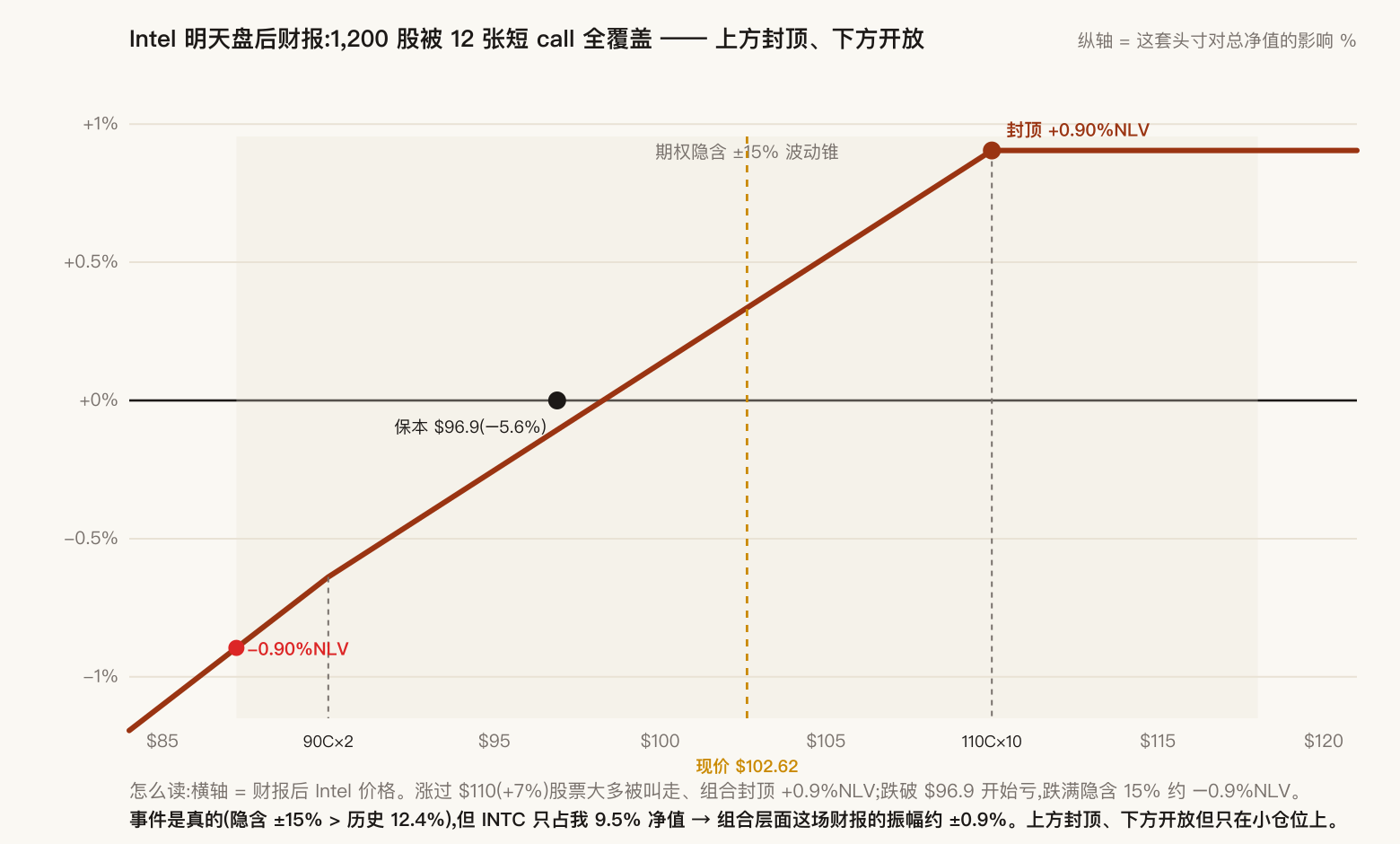
- Capped upside: above $110 (+7%), 1,000 shares get called at 110 and 200 at 90, so this position's contribution to my total NAV caps at +0.90%.
- Open downside: below $96.9 (−5.6%) it starts losing; a full 15% drop is about −0.90% of NAV.
- Breakeven $96.9: the call premium buys roughly a 5.6% downside buffer.
The point is that last clause: the event is real (implied ±15% > 12.4% historical), but Intel is only 9.5% of my NAV, so at the portfolio level this earnings print swings about ±0.9%. Capped upside, open downside — but both only on a small sleeve. That's the "don't concentrate into earnings" rule (Netflix was the cautionary tale) doing its job.
Tomorrow after the bell we'll see. No trade today, and none needed — the machine is doing the reverse rebalance for me, and the only discipline to keep is: roll new notes only with capital freed by expiries, add no new financing.