WRITING
Every Button I Pressed That Day Lost Money. The Account Was Up 5.67%.

I pressed three buttons that day. Add them up after the fact and they lost money. The account was up 5.67%, beating the index by 2.38 percentage points. What made the money wasn't my judgment — it was the 2x leverage the market had added for me the day before.
1. The three buttons I pressed added up to a loss
On 07-30 I acted exactly three times:
| Action | After the fact |
|---|---|
| Sold 5 same-day-expiry 674 calls at 3.70 in the morning | −$5.85/share |
| Bought 200 shares around ten o'clock | +$2.52/share |
| Nineteen seconds later, sold 2 Aug-21 625 calls at 61.09 | −$3.83/share |
The first one was the day's only unambiguous mistake. Sold at 3.70; QQQ closed at 683.55, which makes that call's intrinsic value 9.55 — it was locked in to lose 5.85 a share the instant it was opened. That's the direct bill for "keep pushing the short calls down to at-the-money and harvest time value," on an up day. That playbook won three days this week. All three were down days.
The second and third together are note number nine: buy the stock, immediately sell away everything above 625. Principal lands at 619.94; if it doesn't break 625 by expiry I collect 5.06 a share — 9.3% annualized after financing costs. It showed a paper loss that day because QQQ went up. That is the definition of the structure, not a failure of it: the upside isn't mine.
Add the three up and my active decisions that day were negative.
And the account was up 5.67%.
2. The position that made the money was built by the market, the day before
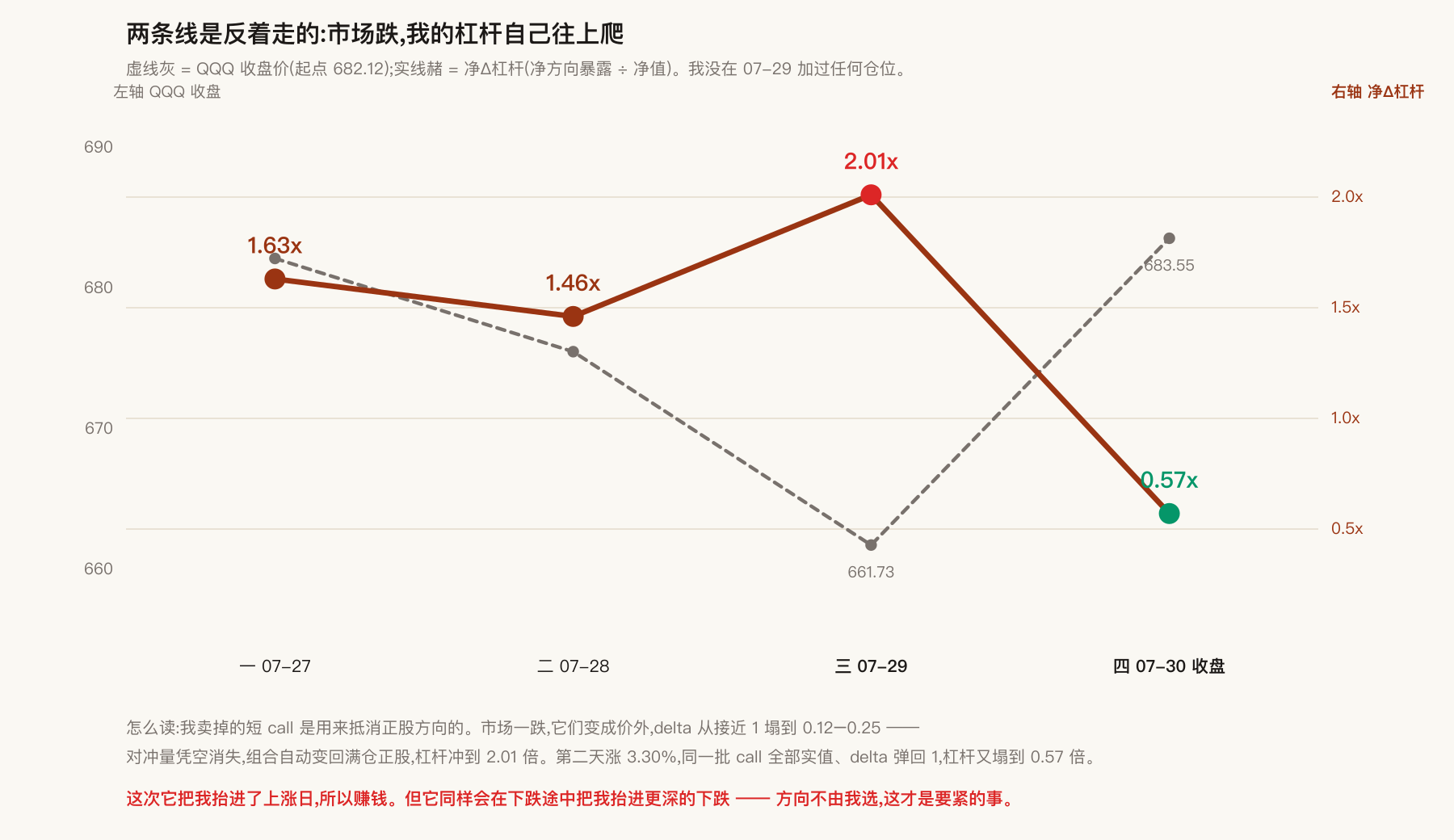
The short calls I sell exist to cancel out the stock's direction. A deep in-the-money call has a delta near 1 — it hedges away the full move on 100 shares for me.
The market drops, they go out of the money, and delta collapses from near 1 to 0.12–0.25.
The hedge evaporates. I did nothing, and the portfolio reverted to something close to fully long — at the 07-29 close, net leverage hit 2.01x, the highest it has been in this stretch.
The next day QQQ rose 3.30%. The same calls went back in the money, delta sprang back to 1, the hedge came back, and by the close leverage had collapsed to 0.57x.
So that's where the 5.67% came from: I walked into that up day carrying 2x leverage, and I didn't put it there.
Broken down, three pieces in order of size: the long-dated call (LEAP) leg, delta near 0.8, pays back on a multiple in a rising market — the single largest contributor; Intel rose 11.30% that day, and most of the calls I'd written against it were far out of the money, so I took that candle almost bare; the stock itself is what's left.
Two days ago, in that review, the LEAP leg was the day's largest drag. Same position, same delta. Only the market's direction changed.
Don't mistake it for skill. It's leverage.
And I don't get to choose which way leverage points — that's the part that matters. This time it carried me into an up day. The same mechanism will carry me deeper into a decline. The more it falls, the heavier my position automatically becomes.
3. Three days below my own line, and on the fourth it fixed itself
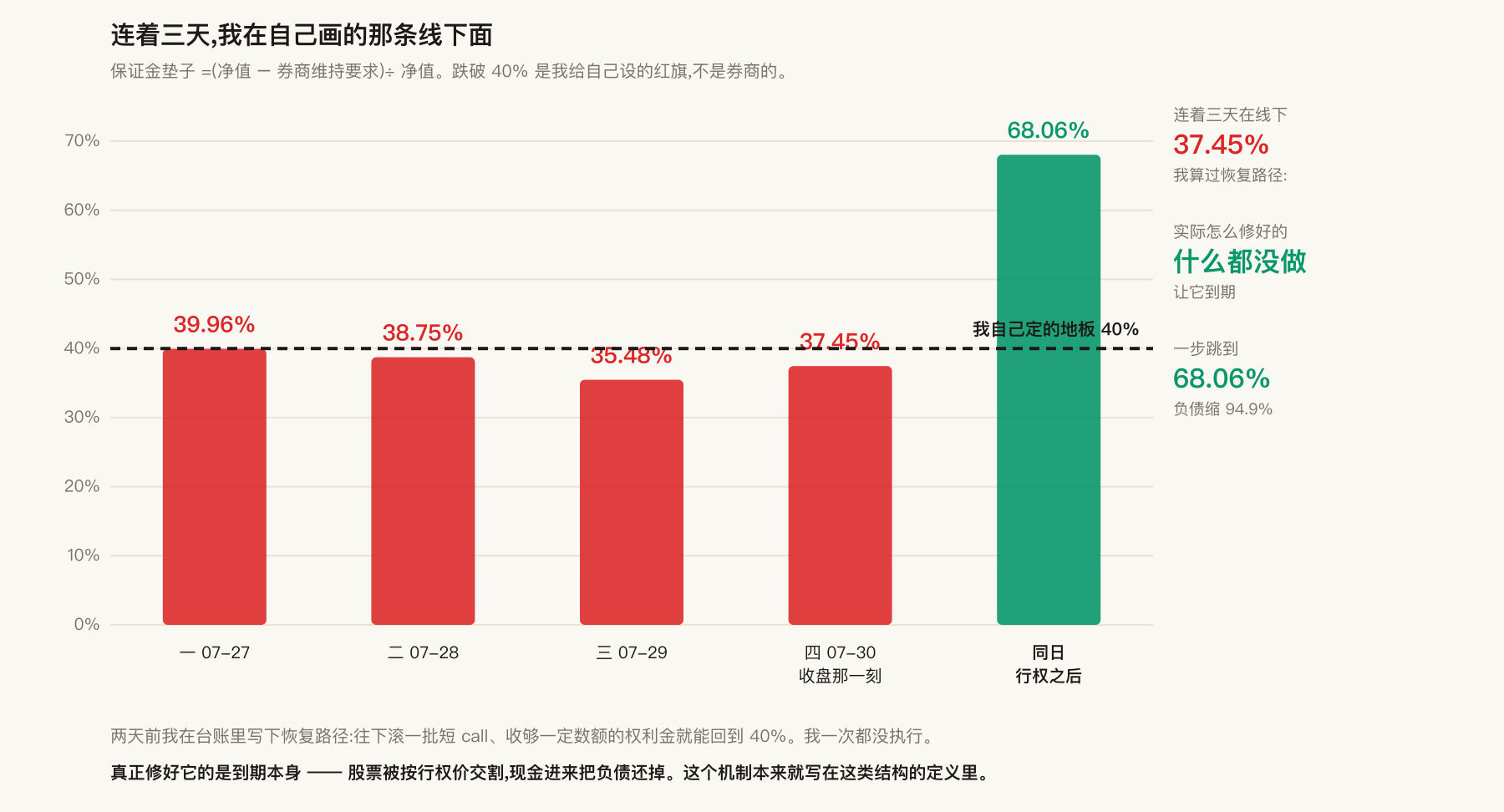
I set myself a rule: the margin cushion — net worth minus the broker's maintenance requirement, over net worth — must not go below 40%.
At the close on 07-28, 07-29 and 07-30, three days running, I was under that line. The low was 35.48%.
Two days ago I worked out the recovery path and wrote it down: roll a batch of short calls down, collect a specific amount of premium, and I'm back at 40%.
I never executed it once.
Then after the 07-30 close, the short calls at four different strikes all finished in the money and were assigned. 64% of the shares I was holding got delivered at their strikes, cash came in, and the debt got paid down. The cushion jumped from 37.45% to 68.06% in one step. Cash debt shrank 94.9%; annual interest was cut 94.8%.
I did nothing.
This isn't luck — the mechanism is written into the definition of the structure. Selling a strike is a promise: above this price I hand the shares over. The moment they're handed over, the cash comes back and the leverage falls by itself. What I'd failed to fix in three days, it fixed in one step.
There's a counterintuitive tail here: total interest fell 95%, but the marginal rate went up. The broker charges the whole balance at one tier's rate, not blended in slices — over a million it's 4.25%; drop under a hundred thousand and it becomes 4.80%. So "less interest" is not "cheaper borrowing." Next time I add, I have to price the tier boundary first.
4. One assignment, three numbers, none of them lying
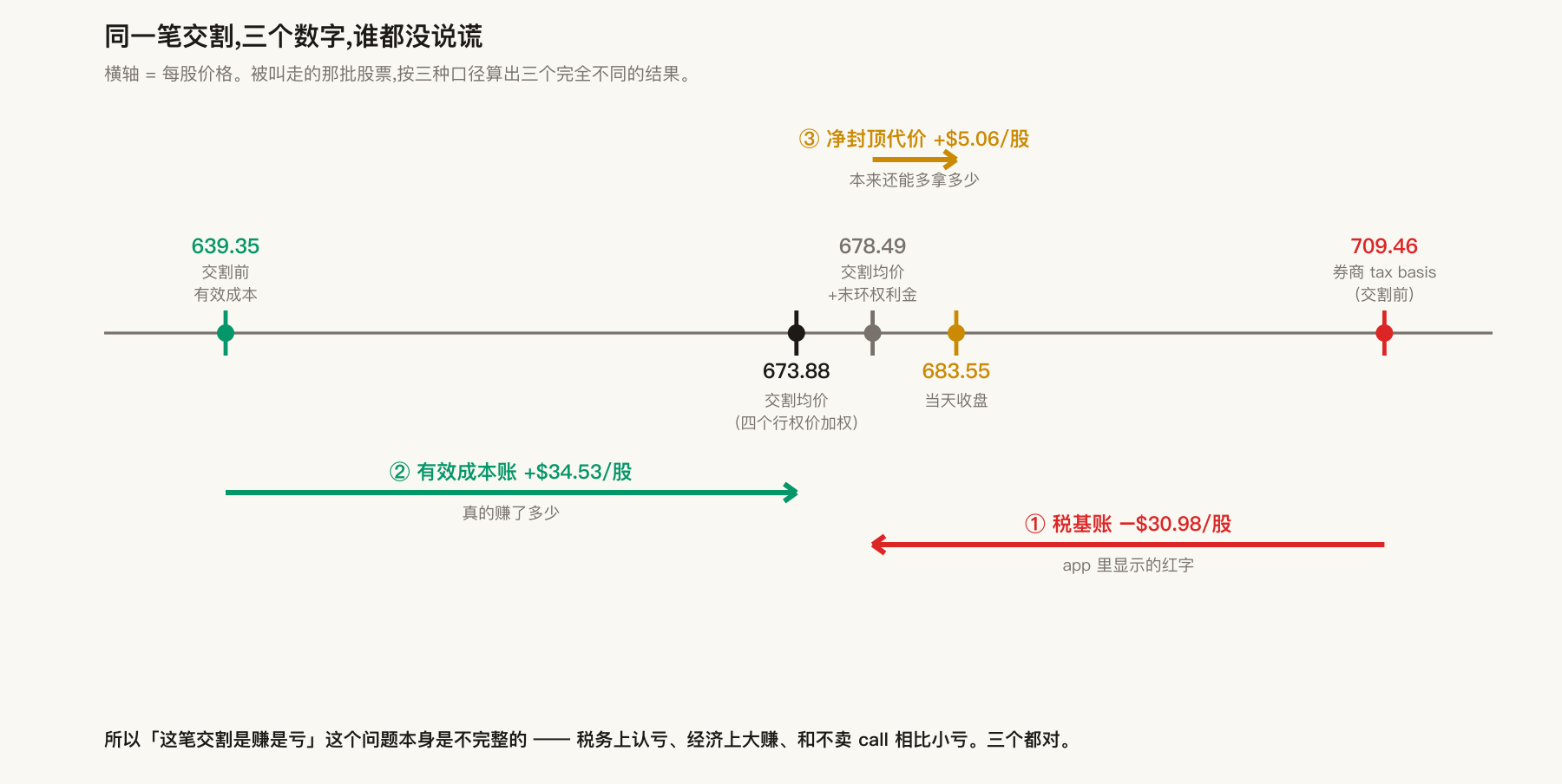
For the shares that got called away, "did this assignment make or lose money" has three answers, and all three are correct:
| Basis | Result | The question it answers |
|---|---|---|
| Broker tax basis | −$30.98/share | The red number in the app |
| Effective cost | +$34.53/share | What I actually made |
| Net cost of the cap | +$5.06/share | What I'd have gotten by not selling calls |
The difference is where the denominator stands.
The broker records what I paid at purchase (709.46). But from the day that position was opened, I have been selling calls against it and rolling them down over and over, and the premium collected has been pushing the real cost down the whole time — by the day of assignment, the economic effective cost was 639.35.
Against 709, I booked a loss. Against 639, I made a lot. Same shares, same day, same delivery price.
And a third number: had I simply held and never sold a call, I'd have gotten 5.06 more a share. That's the price of the ceiling, and it belongs on the record too.
So the next time someone asks "did that trade work," the correct reply starts with a question: which book are you asking about?
One detail I deliberately did not do: the final premium collected is already inside that 639.35, so it must not be added again when computing the effective-cost book. Adding it twice is double counting — that's how this kind of accounting usually dies.
5. What actually flipped that night
Leverage down, debt repaid, cushion thicker. On the surface, that night was all good news.
But something flipped underneath the numbers.
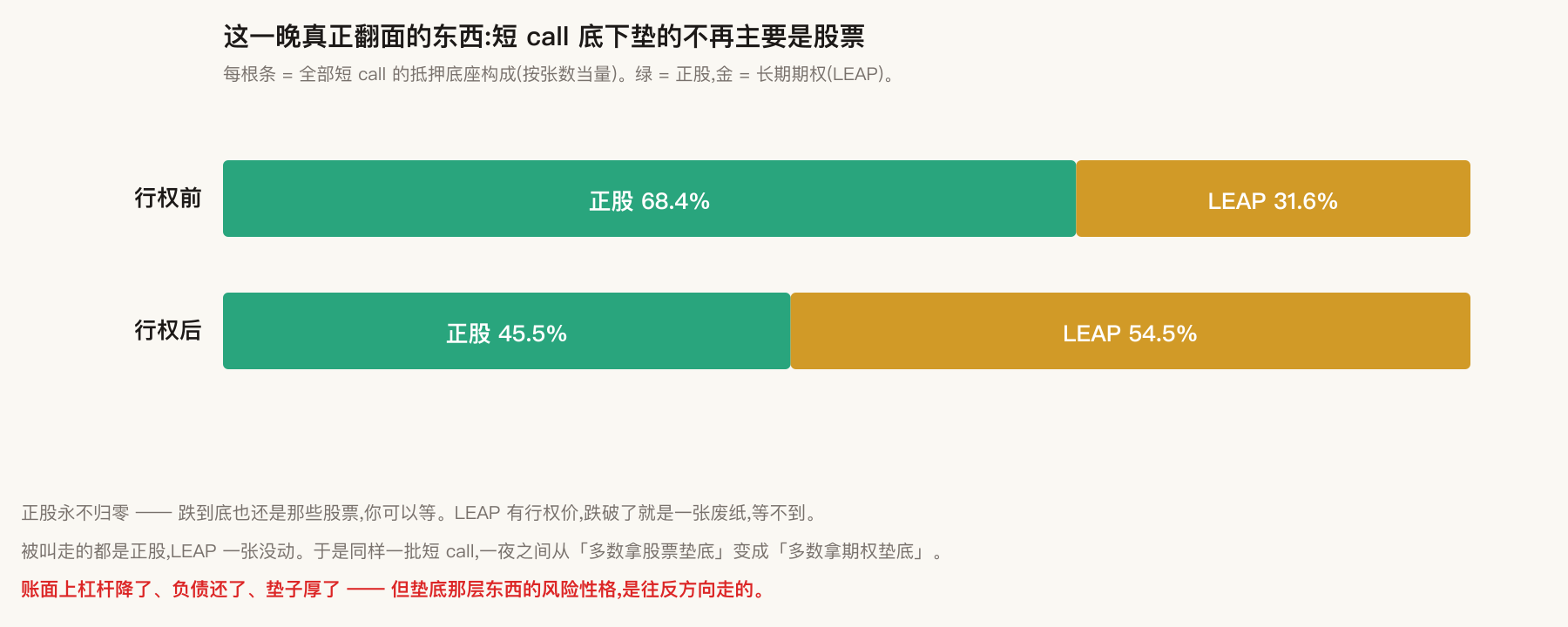
My short calls aren't naked; each has something underneath it — some are backed by stock, some by long-dated options (LEAPs). Everything that got called away was stock. Not one LEAP moved.
So for the same book of short calls, stock's share of the collateral base fell from 68.4% to 45.5% — overnight, this book went from "mostly backed by shares" to "mostly backed by options."
Those two things have different risk characters:
Stock never goes to zero. However far it falls, it's still those shares. You can wait — three years if you have to.
A LEAP has a strike, and below it, it's paper. You don't get to wait.
So I can't relax just because leverage went down. All three of my safety gauges improved, while the nature of the layer underneath moved the other way. That's exactly when it's easiest to get comfortable — because every dashboard is green.
6. The scoreboard
| Me | QQQ | |
|---|---|---|
| 07-30 | +5.67% | +3.30% |
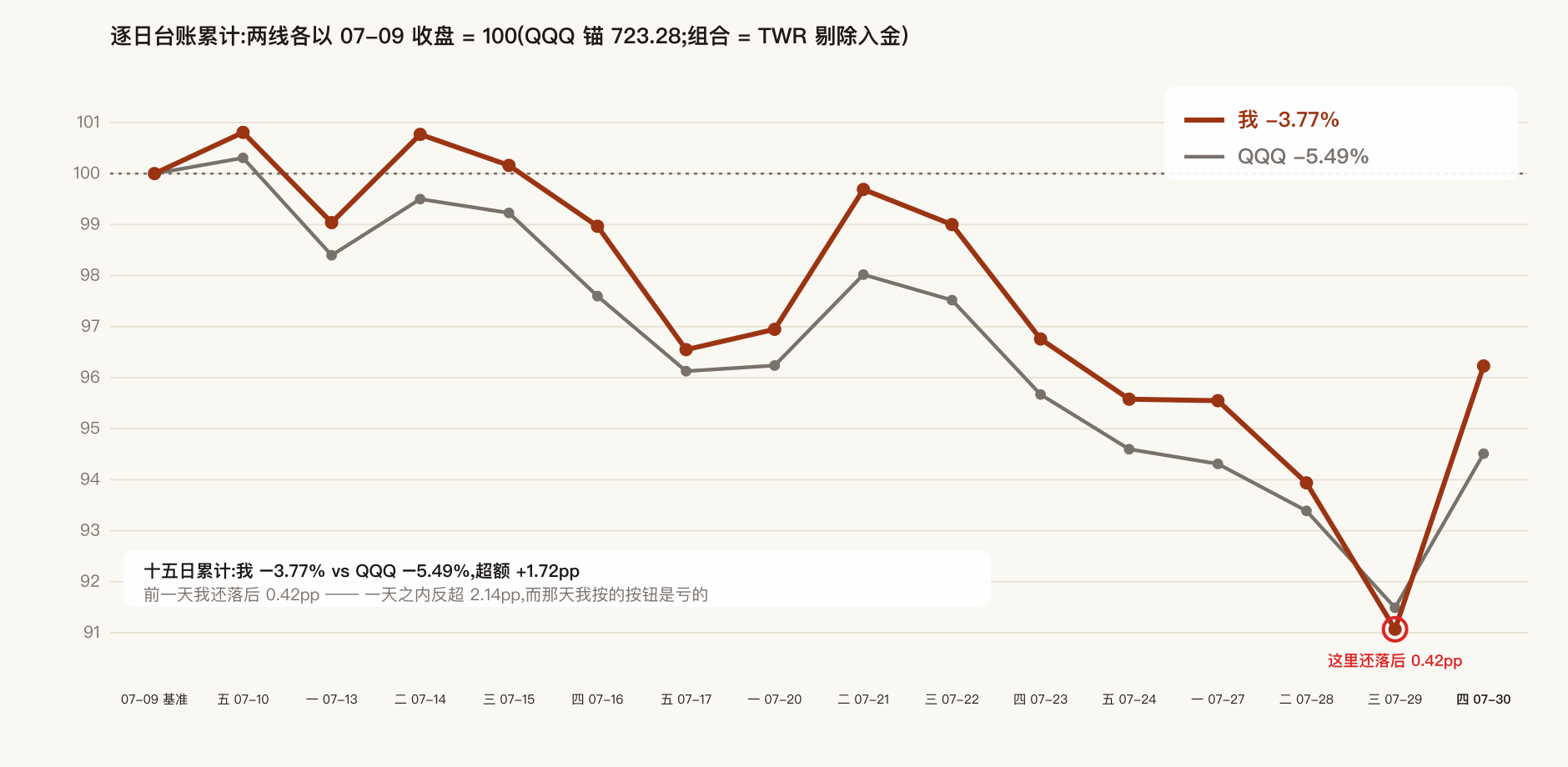
| Fifteen days cumulative | −3.77% | −5.49% |
| Excess | +1.72pp |
The day before — at the 07-29 close — I was behind by 0.42 percentage points, the low of this stretch. A 2.14pp swing in a single day.
I circled that point on the chart on purpose. Because if you only look at the month-end number, you'd draw a completely wrong conclusion: "See, selling calls with leverage works."
What worked was that one day's direction.
The leg-level attribution ties to the change in net worth to the dollar — zero residual. I checked that; it isn't an estimate.
7. What I took from this day
Not "should I sell calls," and not "how much leverage is right." Something more basic:
I thought my position was something I chose. In fact I only chose the rule. The position is what the market computes from that rule.
What I chose was: sell away everything above a given strike. Once that rule is live, my actual directional exposure belongs to the market — it falls, my leverage climbs on its own; it rises, my leverage collapses on its own. I'm a spectator in the middle.
That day it swung the right way and I made money. Which makes the inverted question the one worth asking:
What if 07-29 had been followed by more downside?
The same mechanism would have walked me into a second down day at 2x, and then a third. The more it falls, the heavier the position gets by itself. This isn't a hypothetical. It's the other half of the same machine.
Every button I pressed that day lost money. The account was up 5.67%.
It's the first half I want to remember.