WRITING
The Benchmark Bill for Three Subscriptions: K3 for Volume, Claude for Quality, GPT for Spikes
I pay for three AI subscriptions: Kimi, Claude, GPT. Three charges hit my card every month without fail, but honestly, the division of labor has always been gut feel — coding in this one, writing docs in that one, never actually doing the math.
Last week Kimi K3 launched with an official comparison: 14 benchmarks, K3 vs Claude's new flagship Fable 5 vs GPT-5.6 Sol, all with thinking effort maxed out. I transcribed both charts line by line, checked them against how I actually used the three over the past month, and re-routed my five daily task types.
The conclusion up front: Kimi K3 as the daily workhorse, Claude for final-draft quality and visual understanding, GPT for deep-reasoning spikes and terminal puzzles. Here's the math.
1. The 14-benchmark scoreboard: nobody sweeps, but the win distribution reveals personality
Group the 14 benches by winner:
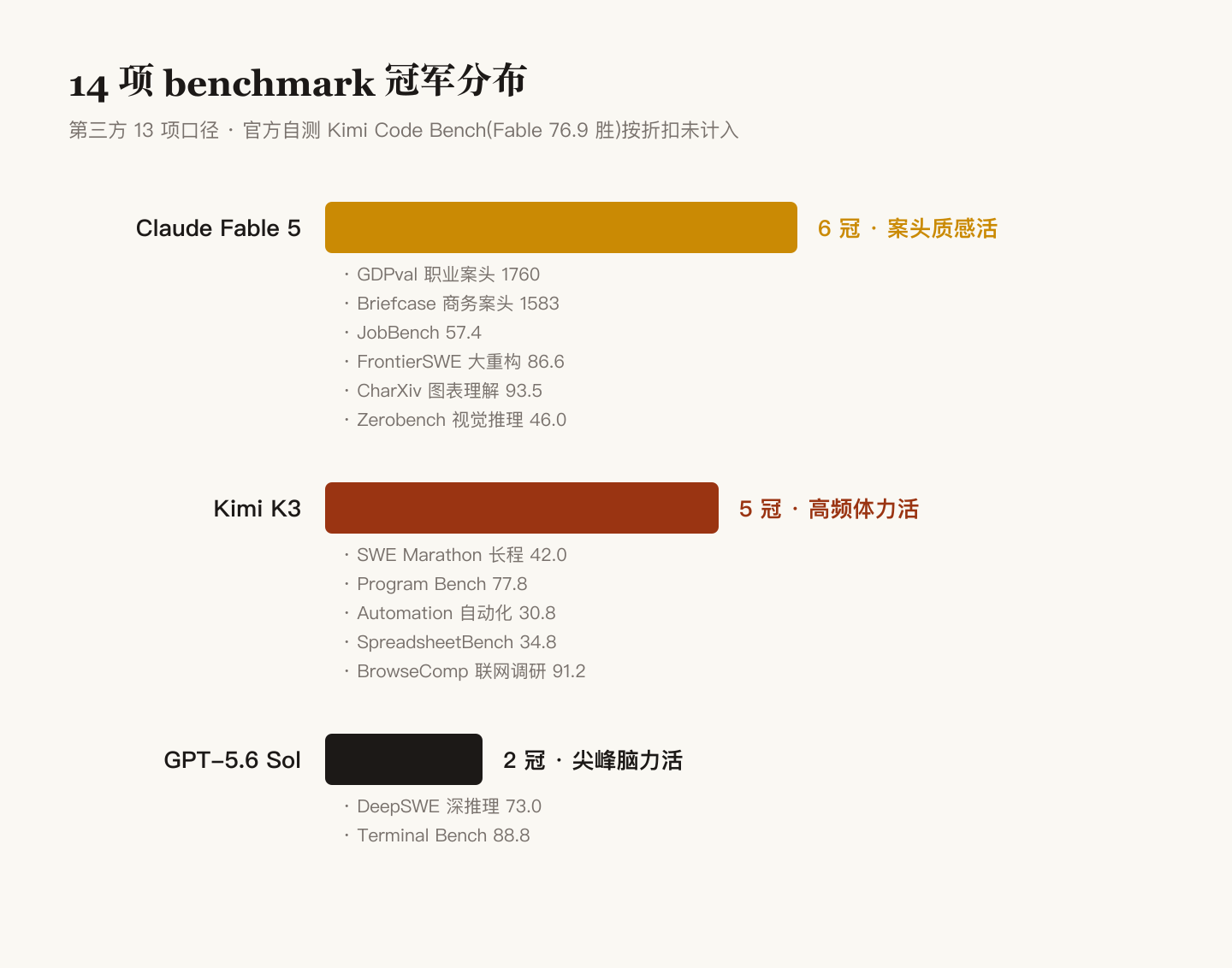
Fable 5 leads by a nose on third-party count, but look at where the wins land:
- K3's five: SWE Marathon (long-horizon software engineering, 42.0 vs runner-up 40.0), Program Bench (77.8), Automation Bench (30.8), SpreadsheetBench (34.8), BrowseComp web research (91.2).
- Fable 5's six: GDPval professional work (Elo 1760), Briefcase business tasks (1583), JobBench (57.4), FrontierSWE large-scale refactoring (86.6), CharXiv chart understanding (93.5), Zerobench visual reasoning (46.0).
- GPT-5.6 Sol's two: DeepSWE deep reasoning (73.0), Terminal Bench (88.8).
See the personalities? Everything K3 wins is high-frequency grunt work — long-horizon agentic coding, web research, automation, spreadsheets. That happens to be what I invoke most often every day. Everything Fable 5 wins is desk-quality work — professional documents, business writing, visual understanding. GPT-5.6 wins peak-brain work — single-point deep reasoning and terminal operations.
Terminal Bench deserves a footnote: GPT-5.6 scored 88.8, K3 scored 88.3 — a 0.5 gap, effectively a tie — while Opus-4.8 and Fable 5 both sit at 84.6.
2. The six coding benches: long-horizon agentic is the dividing line
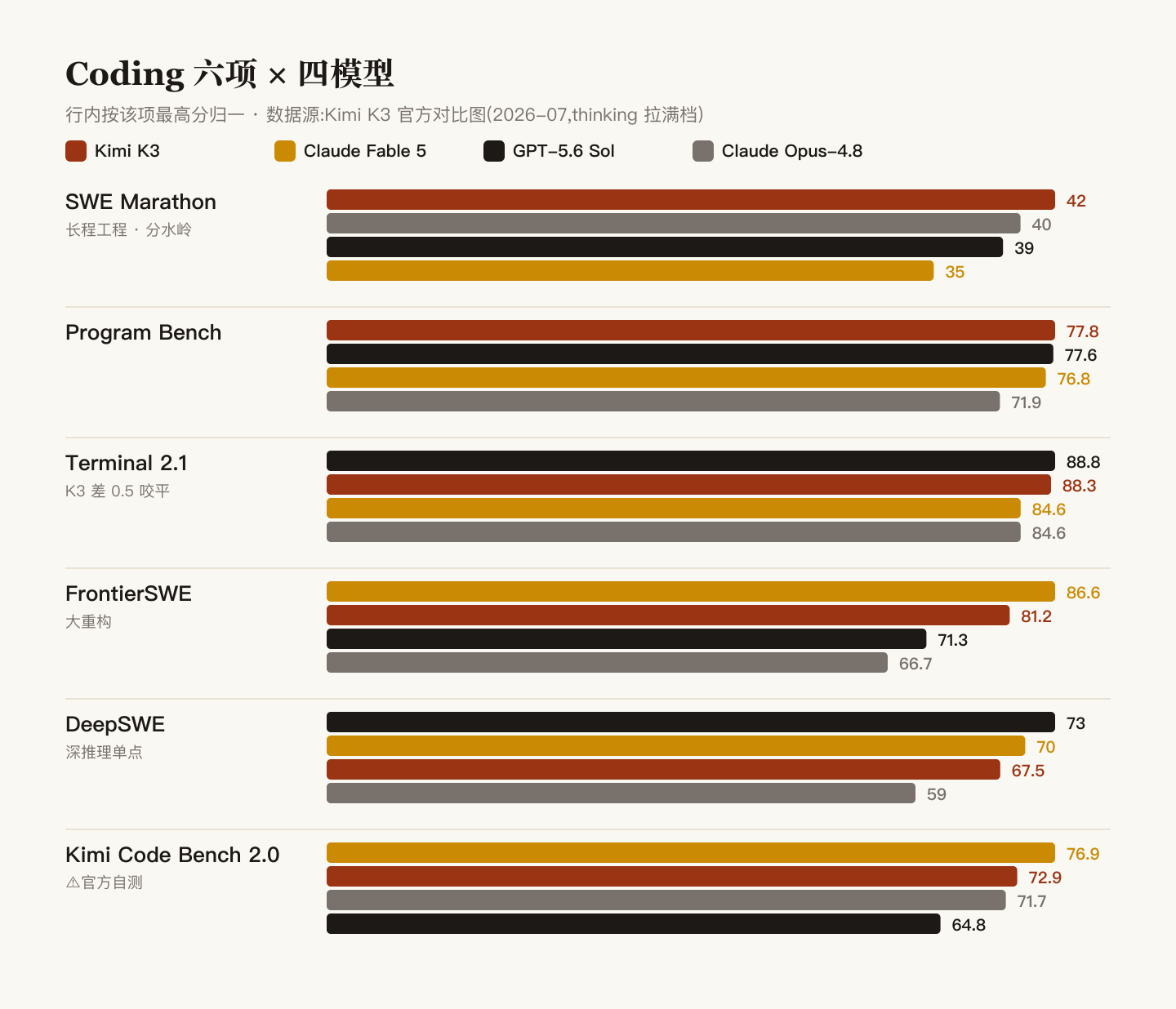
Coding is what I care about most. The densest signal of the six is SWE Marathon: it doesn't test whether one snippet is correct, but sustained engineering across hours and dozens of tool calls — exactly my main battlefield with AI.
K3 leads here at 42.0, Opus-4.8 second at 40.0, GPT-5.6 Sol third at 39.0. GPT-5.5? Only 14.0 — two generations of the same family, a nearly 3x gap in long-horizon ability.
This isn't paper data for me. The raw material of this very post came from a textbook long-horizon K3 run: I asked it to audit my entire options-trading workspace. It fanned out 6 parallel sub-agents to map the territory, then 5 more to execute fixes — 70 file changes, 41 archive moves, 100 tests green, zero doc-consistency violations, one pass. It hit a quota cap once mid-run, resumed, and kept going.
But honesty first: on DeepSWE (deep reasoning), GPT-5.6 leads at 73.0, clearly ahead of Fable 5's 70.0 and K3's 67.5. For the "think for half an hour before writing a line" kind of hard algorithm problem, GPT-5.6 is still the pick.
3. Web research and automation: K3's two "invisible crowns"
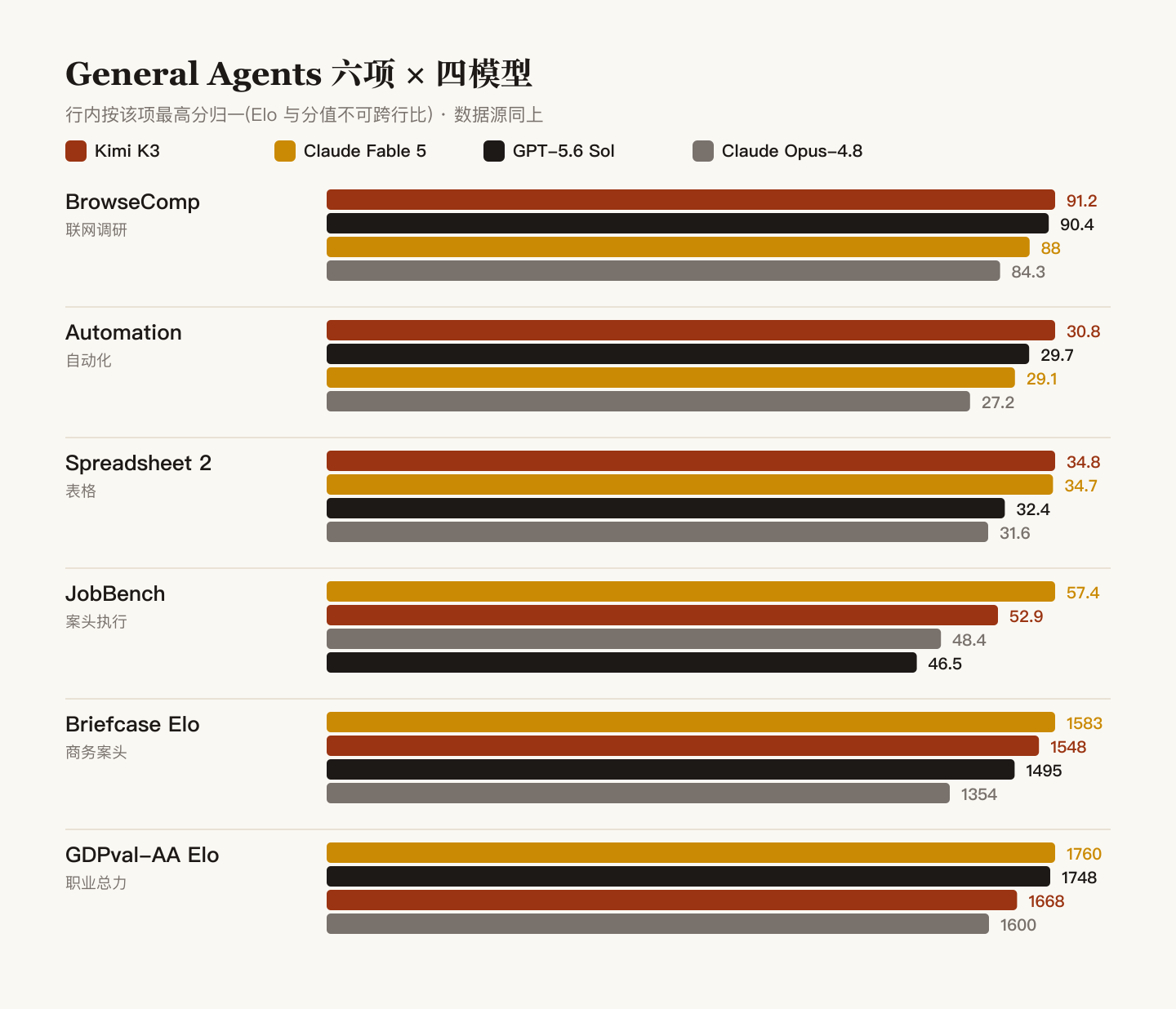
Content creators should stare at BrowseComp (web research): K3 91.2 first, GPT-5.6 90.4 close behind, Fable 5 only 88.0. Topic selection, material gathering, fact-checking — the first half of a self-media workflow is research, and this win decides who gets that job.
Automation Bench also goes to K3 at 30.8. Add SpreadsheetBench (34.8 vs Fable's 34.7, a photo finish), and for the daily "run a script and tidy this data" work, K3 is the answer.
4. My routing table for five task types
Translated into my own division of labor. I have exactly five daily task types:
| Task | Primary | When to switch |
|---|---|---|
| Code (harness/engines/web pages) | K3 | Single-point deep-reasoning algorithms → GPT-5.6; greenfield architecture / big refactors → Fable 5 |
| Writing docs (reports/long-form) | Drafts & revisions K3, important final drafts Fable 5 | Mechanical formatting → subcontract to Opus-4.8 |
| Self-media (Xiaohongshu/WeChat/X) | Research + first drafts K3 | Final voice polish → Fable 5 |
| Video | Video analysis / frame understanding Fable 5 | Scripts and narration follow the self-media row; none of these models generate video |
| Image generation | Dedicated image models | Prompt engineering / HTML-SVG graphics → K3; checking generated images → Fable 5 / K3 |
Two extra notes:
- Video and image generation aren't covered by these 14 benchmarks at all. Language models produce neither. The only vision-adjacent items are CharXiv and Zerobench, two "visual understanding" tests — for watching videos and inspecting generated images. Fable 5 wins both, K3 is second on both, ~2 points behind.
- Opus-4.8 wasn't eliminated — it was demoted. It now only takes mechanical subcontract work. That's not a performance judgment but a cost judgment: Fable quota is precious, simple work gets explicitly delegated to Opus.
5. Two buckets of cold water
First: one of the 14 (Kimi Code Bench 2.0) is the vendor's own test. I discounted it and excluded it from the core evidence. The other 13 are third-party or public benches — more trustworthy.
Second: every number was produced with thinking effort maxed out. In the low-effort mode of daily quick Q&A, the ranking could shuffle entirely. This routing table only holds for heavy work — for light tasks I use whichever window is open.
Closing
Three subscription fees used to be insurance premiums for "just in case." Now each has its post: K3 carries the volume, Claude carries the quality, GPT carries the spikes.
Benchmarks will change, models will turn over, and this table probably has a two-to-three-month shelf life. But the idea of routing by task personality won't expire — when the next model drops, plug its scores into this table and re-route.