WRITING
Another Knife at 693, Floored at 646: On Expiry Day Not a Single Share Was Called Away, and Debt Climbed to 88%

July 17, 2026, Friday — July's monthly expiry. Day six of the chip selloff, and the day it formally graduated from "thematic pullback" to "sector correction": the Philadelphia Semiconductor Index is down about 20% from its high, Korea's market hit −6.4% intraday and tripped its sidecar circuit breaker, the Nasdaq Composite closed −1.40%, my index −1.51%. The streaming giant that reported last night opened straight into a 52-week low and closed −7.3%.
The last paragraph of yesterday's post said: "22 short calls await their delivery verdicts; the debt valve rings by itself in 24 hours."
Today it rang. The answer was: not a single share called away.
1. The expiry verdict: the valve rang, and what it said was "don't repay"
First, how this valve works. I hold 3,100 shares of the index plus a set of long-dated calls used as stock replacement, and written against them are 22 short calls — the "homemade note" I run year-round: sell tomorrow's upside, collect today's certain premium.
Expiry has only two outcomes, and neither one requires a judgment call from me:
- Close above the strike — shares are automatically called away by the clearinghouse at the strike, cash lands, margin debt drops hard in one step. This is my cheapest way to trim: no spread, no market impact, no commission.
- Close below the strike — the options expire worthless, 100% of the premium is banked, not one share moves, and not one dollar of debt is repaid.
The index closed at 695.30. The lowest of my 22 short calls sat at 702. Every one of them closed below its strike.
So here's what actually happened: in the nine minutes between 09:44 and 09:53, I bought back all 22 calls across the 702 / 705 / 710 strikes for essentially nothing (0.28 / 0.16 / 0.06 per share), and simultaneously sold the same strikes out to August 21 at 700 / 705 / 710, for **net proceeds of 1,554. Over thirty-seven thousand dollars of premium in, and not a single share moved.
That is the asymmetry of this business: when it rallies, the short calls repay my debt for me; when it falls, they pay me cash but repay nothing. Today was the second one. And I didn't just fail to repay — I borrowed more. That's the next section.
2. Same template, one more rung welded below
Yesterday's structure was: buy 1,000 shares at 708.31, and in the same minute sell the 680 covered call for 42.31 — net outlay 666.00, capped at 680, breakeven 666.00.
Today at 09:58, with the index another two points lower, I moved the entire template down one notch:
- Bought 400 shares, filled at 693.08;
- 13 seconds later sold 4 August-21 660 calls, collecting 46.50 per share.
Net outlay = 693.08 − 46.50 = 646.58. Capped at 660. Full coupon = 660 − 693.08 + 46.50 = 13.42 per share, $5,368 total; 35 days, 2.08% on net outlay, 21.7% annualized — nearly identical to yesterday's 21.3%, because it is the same trade, just shifted down 15 points.
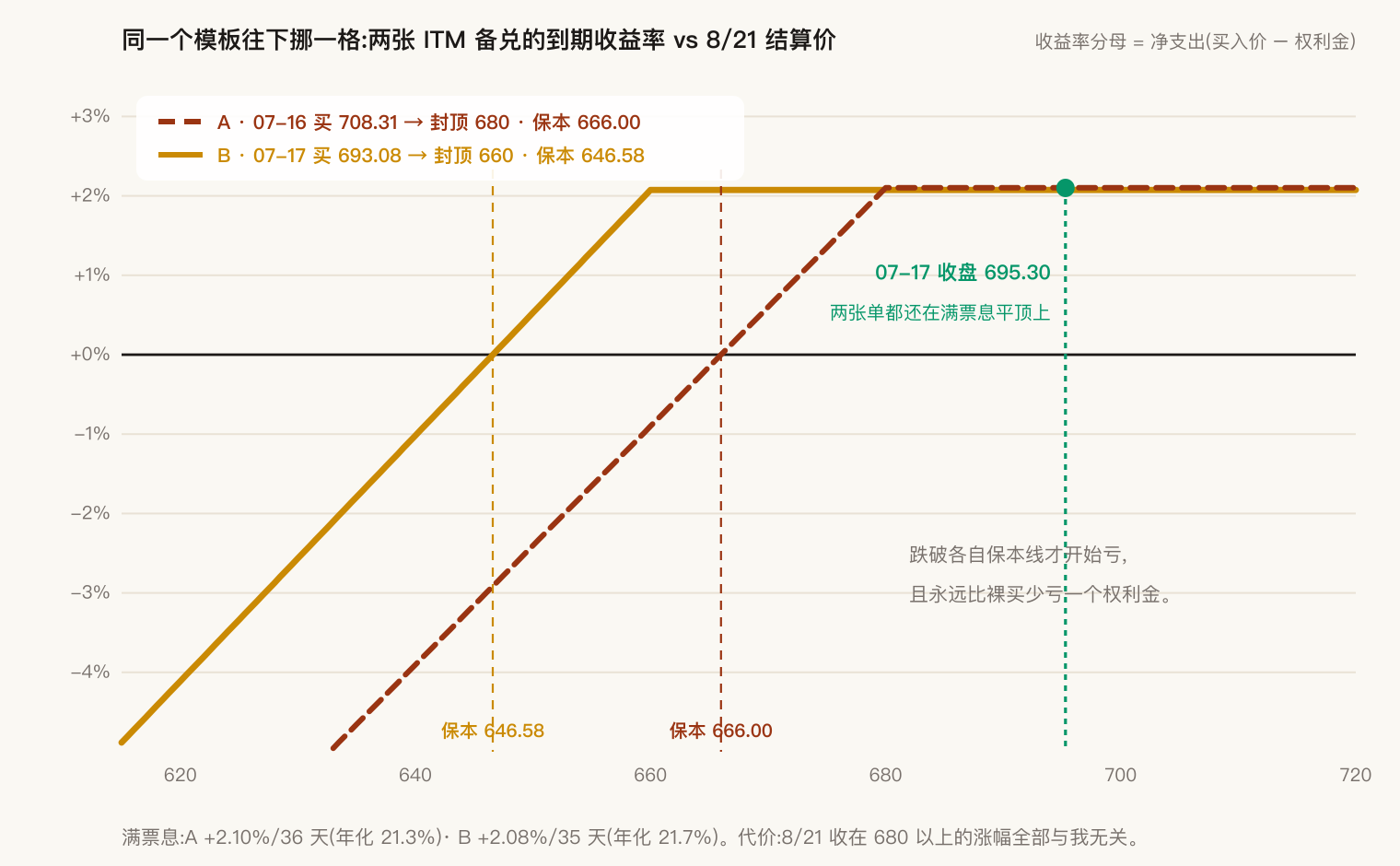
Why lay another rung? Because I'm not calling a bottom — I'm building stairs. Every rung carries three numbers written down before the order goes out: where I buy, where I'm capped, where I start losing. Each notch lower the index goes, I weld a new rung down there, each with its own floor. That way "it dropped after I bought" isn't a failure — it's the work order for the next rung.
But this logic has a boundary that has to be said out loud: how many rungs I can lay depends on how much I can borrow, not on how much I want to buy. That's what actually deserves judgment today.
3. The honest ledger: debt from 69% to 88%
Three days ago I published a post about debt stair-stepping from 107% down to 19%. Yesterday's buy pulled it to 69%. Today I bought again, nothing was called away, and margin debt now stands at $1,112,019 — 88% of net value.
Three days: 19% → 69% → 88%. That direction goes in writing, unadorned.
Three things I owe myself, same as yesterday, plus one new one:
- What I borrowed isn't naked exposure. Written against 3,100 shares plus the replacement LEAPs are 49 short calls; the deep in-the-money strikes hedge away most of the directional exposure, so the portfolio's net direction is far below what "debt ÷ net value" implies. Repayment obligation and directional risk are two separate ledgers — they don't get to comfort each other, and they don't get to scare each other either.
- The valve is still there; it just didn't ring the note I wanted. August 21 gives another chance, and before then, any bounce back above 700 starts repaying automatically.
- The new one: the cushion is getting relatively thinner. Yesterday the short-call cushion absorbed 68% of the long-side loss; today only 44%. The reason isn't subtle — the long side grew and the rent didn't keep up. Adding longs while expecting the same premium to cushion a bigger book is arithmetically impossible. That is the mechanical cause of today's underperformance, not bad luck.
4. The first day the cushion didn't hold
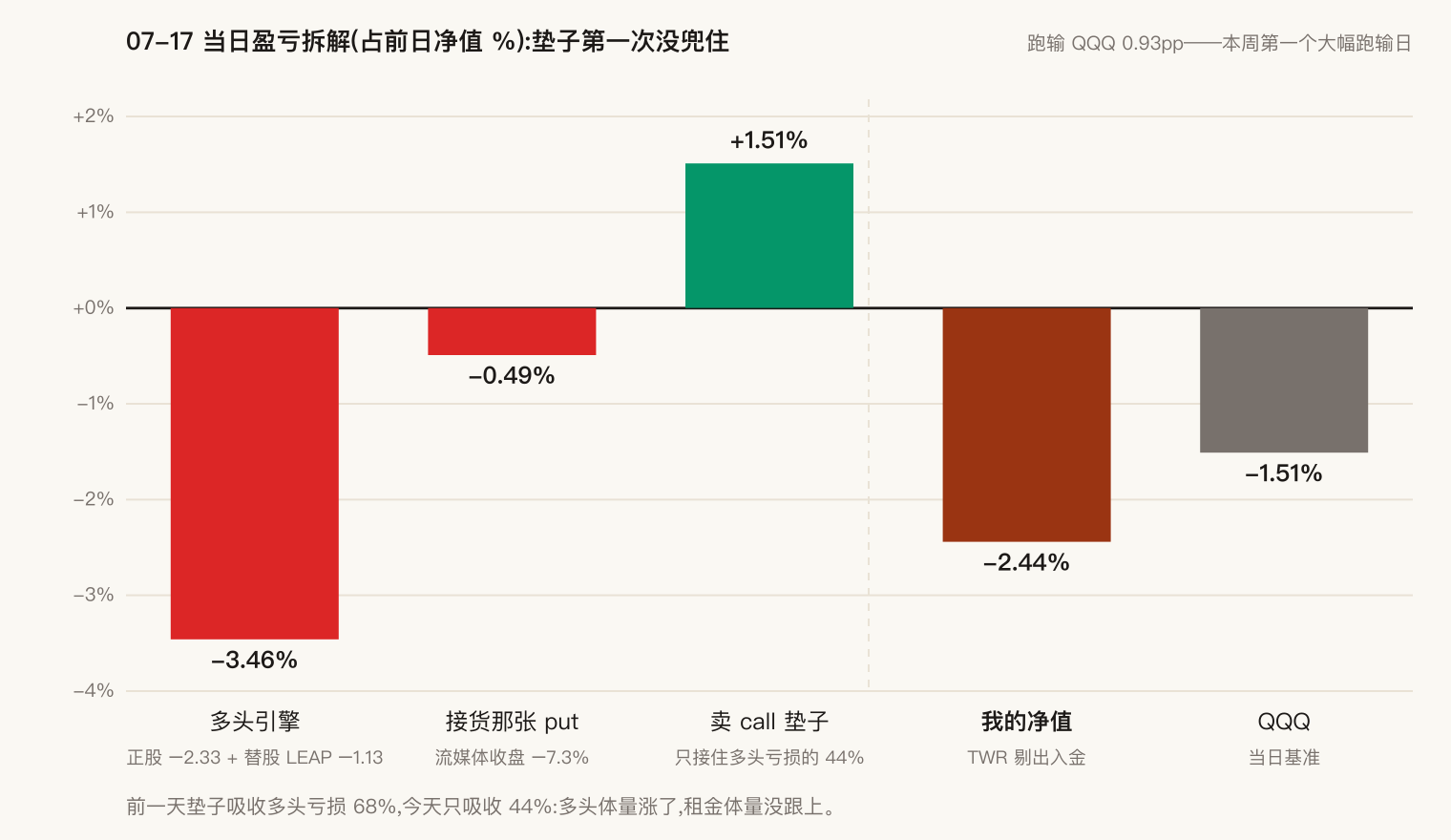
One sentence: leverage charges double in a down tape, and I spent this whole week adding leverage. There's nothing to argue about — it's the clause I signed: upside capped, downside levered, premium filling the middle. I chose it; today I pay the invoice.
5. Delivery: the first one, and not handled well
Last night I wrote "take delivery as contracted." Today I did — but there's an action in between I have to log.
At 14:30 I placed an order: roll the eleven 75-strike puts from today out to August 21 for a mere 1.00 of credit. In plain words, that was trying to run — don't take delivery, stall another month, bet on a bounce.
It didn't fill. I cancelled before the close and went back to the verdict I'd already written: take delivery as contracted.
Now the accounting:
| Item | Number |
|---|---|
| Delivery | 1,100 shares @ 75 |
| Rent this condor collected | 2.80 per share |
| Effective cost basis | 72.20 |
| 07-17 close | 68.86 (broker mark) |
| Underwater on arrival | −4.6% |
| Cash out | −$82,500 |
| The condor's other three legs (60 put / 90 call / 110 call) | All expired worthless, premium banked |
Two separate things.
What I got right: the full sentence behind selling a put has always been "I am willing to buy this at 75." The market handed that sentence back verbatim, and I honored it literally. For a company down 45% from last year's high and still beating on earnings, I'll own a 72.20 cost basis. The first move after delivery is already queued: sell calls against it and start collecting rent — the same assembly line that ground the chip name's effective cost from 111 down to 71 gets run again, unchanged.
What I got wrong: two things. First, the playbook says in black and white close before earnings, and the plan to flatten this position slipped from last week to the session of the print and never executed — earnings are on the calendar; this was no black swan. Second, that 1.00 roll order this afternoon. It was not a risk-management action, it was an escape attempt: I had already published "no closing — take delivery as contracted" last night, and this afternoon I tried to slip out. It not filling was luck, not discipline. Into the violations ledger, right under yesterday's entry.
6. Scoreboard: one day ate two-thirds of the excess
| Session | Tape | My portfolio | QQQ | Excess |
|---|---|---|---|---|
| Fri 07-10 | chip grinder | +0.81% | +0.31% | +0.50pp |
| Mon 07-13 | more selling | −1.76% | −1.90% | +0.14pp |
| Tue 07-14 | CPI rebound | +1.74% | +1.12% | +0.62pp |
| Wed 07-15 | give-back | −0.60% | −0.27% | −0.33pp |
| Thu 07-16 | deepest of five | −1.19% | −1.64% | +0.45pp |
| Fri 07-17 | expiry + sector correction | −2.44% | −1.51% | −0.93pp |
| 6-day cumulative | one way, down | −3.45% | −3.86% | +0.41pp |
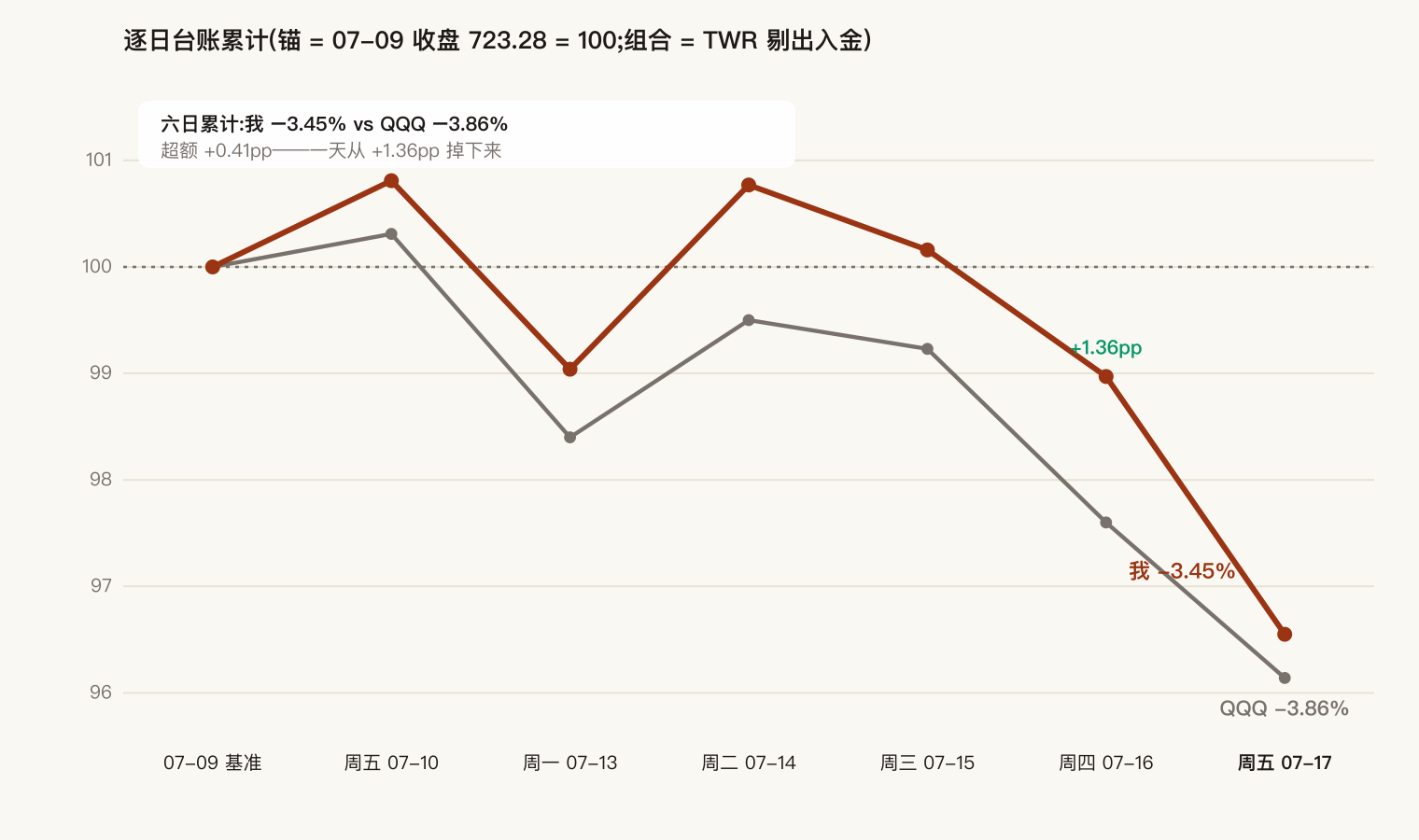
Conventions in full: the portfolio is TWR (deposits excluded), anchored to 07-09's close of 723.28 = 100. Both lines are underwater; my 0.41-point lead only means "lost a little less."
Close
Yesterday I said the best way to buy a dip is to write the "what if I'm wrong" price into the order first. Today was the stress test, and it returned three answers of three different kinds:
The structure works as designed. Both trades still sit on the full-coupon plateau; every number existed before the order did. However the tape falls, it is testing the structure.
Leverage charges full price. The expiry valve did not repay my debt, and I borrowed more anyway; the cushion's relative thickness fell from 68% to 44% and cashed out same-day as 0.93 points of underperformance. Those are the terms I chose, not the market being unfair.
Discipline cracked. Last night I wrote "take delivery as contracted"; this afternoon I placed an order trying to run. It not filling was luck. Publishing it is the point — so that next time my hand shakes before I place that order.
Monday: 3,100 index shares, 49 short index calls, and 1,100 freshly delivered shares, all on the field. On August 21, the valve rings again.
Sources: The Motley Fool — Stock Market Today, July 17: Stocks Slide as Semiconductor Rout Deepens · CNBC — Netflix stock falls as earnings forecast disappoints · Fortune — Netflix stock hits 52-week low after earnings · Saxo Bank — Options Brief: Chip jitters into expiry, 17 July 2026